
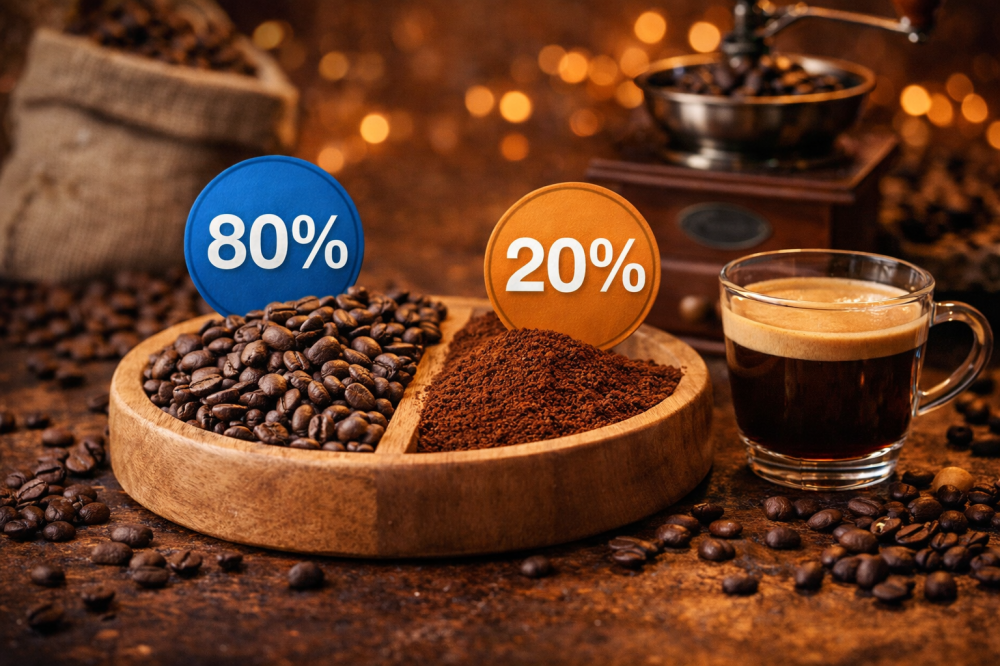
In the world of specialty coffee, where every coffee lover strives for the perfect cup that combines balance, depth, and purity, a simple yet powerful rule stands out: the "80/20 rule," sometimes called the "Pareto Principle." This rule isn't just a theory; it's a practical tool that has helped thousands of baristas, professionals, and enthusiasts improve the quality of their coffee without getting bogged down in exhausting details. The rule's core idea is this: 80% of the quality of the final cup of coffee is achieved by effectively controlling just 20% of the influencing factors . In other words, a very limited number of variables, if mastered, will most of the time yield excellent results, while the other details (which constitute 80% of the effort) add only a relatively minor improvement (only 20% of the overall quality).
This article explains the rule in detail, prioritizes the 20% that are most influential, and shows how you can apply it practically whether you are a beginner or a professional, with straightforward tips to avoid wasting time and money on minor details.
What is meant by the 80/20 rule in the context of coffee?
The Pareto Principle—or the 80/20 rule—states that 80% of the results come from 20% of the causes or efforts. In the world of coffee, this translates to the fact that most of the quality of the final cup (flavor, balance, acidity, body, clarity) is determined by a very small set of factors, while many other factors have a relatively minor influence.
The 20% that most influence coffee quality (ranked by actual priority)
- Grain quality and freshness (undisputedly the primary factor): If the grain is old or of low quality, no amount of adjustment to milling, temperature, or pouring method will help. → Fresh specialty grains (roasted 7 to 21 days prior) account for 40–50% of the final quality.
- The coffee-to-water ratio is generally considered the most acceptable and consistent ratio, typically 1:15 to 1:17 (1 gram of coffee to 15–17 grams of water). Changing the ratio slightly (such as going from 1:16 to 1:15.5) has a greater impact than significantly changing the grind size.
- The grind size, or the grind appropriate for the brewing method, is the third most influential factor. A very coarse grind results in bland, weak coffee; a very fine grind results in bitter, over-extracted coffee.
- Water quality: Low to medium mineral content (TDS between 75–175 ppm) is best. Very hard or chlorinated water destroys subtle flavors.
- The ideal water temperature range is 90–96°C. Most people achieve excellent results at 92–94°C.
The remaining 80% (details that add only 20% to the quality)
- The exact shape of the casting (slow circular, intermittent, central)
- Filter type (white or brown paper, metal or fabric)
- Type of dredger or tool (V60, Kalita, Con, Oryx, etc.)
- The extraction time is extremely accurate (e.g., 2:48 instead of 3:00).
- The exact roasting level (Light vs Medium Light with a slight difference)
- Humidity level in the room during preparation
- Stirring or Blooming Method
These factors are important, but their impact becomes minimal if the first 20% are not well controlled.
Frequently asked questions about the 80/20 rule in coffee
Q: Does the 80/20 rule apply to all preparation methods?
A: Yes, whether you are using a V60, Chemex, Aeropress, French Press, Mocha Pot, or even Espresso.
Q: If I am a complete beginner, what should I focus on first?
A:
- Buy freshly roasted grains that are less than 3 weeks old
- Use an accurate scale to measure the coffee and water.
- Grind the coffee freshly ground just before brewing.
Q: Does the coffee storage container count towards the basic 20%?
A: Yes, because it keeps the grains fresh (factor number 1).
In the luxury of coffee, we provide professional, airtight stainless steel storage containers (1.2 liters, 1.35 square liters, 1.7 liters, and some electronic models with a vacuum pump).
Q: Do I need to buy an expensive grinder to achieve 80% quality?
A: No, a good manual grinder (like the Timemore C2 or C3) or a medium-quality electric grinder is quite sufficient to start with. Consistency in grinding is key.
Q: What is the best ratio for beginners?
A: Start with a ratio of 1:16 (e.g., 15 grams of coffee to 240–250 ml of water), then adjust to your liking afterwards.
In short: Focus on the basics, and you'll get excellent results.
The 80/20 rule teaches us a valuable lesson: coffee excellence doesn't require excessive complexity, but rather a careful focus on the right fundamentals.
- High-quality fresh grains
- accurate ratio
- Freshly ground and suitable
- Good water
- Proper storage
All these items are available at Rafahiyat Al Qahwa with high quality and reasonable prices:
- Fresh specialty grains, roasted to order
- Professional stainless steel storage containers (1.2L, 1.35L square, 1.7L, electronic with vacuum pump)
- Manual and electric grinders suitable for all skill levels
- A precise scale, distillation tools, filters, and everything you need to easily apply the base