
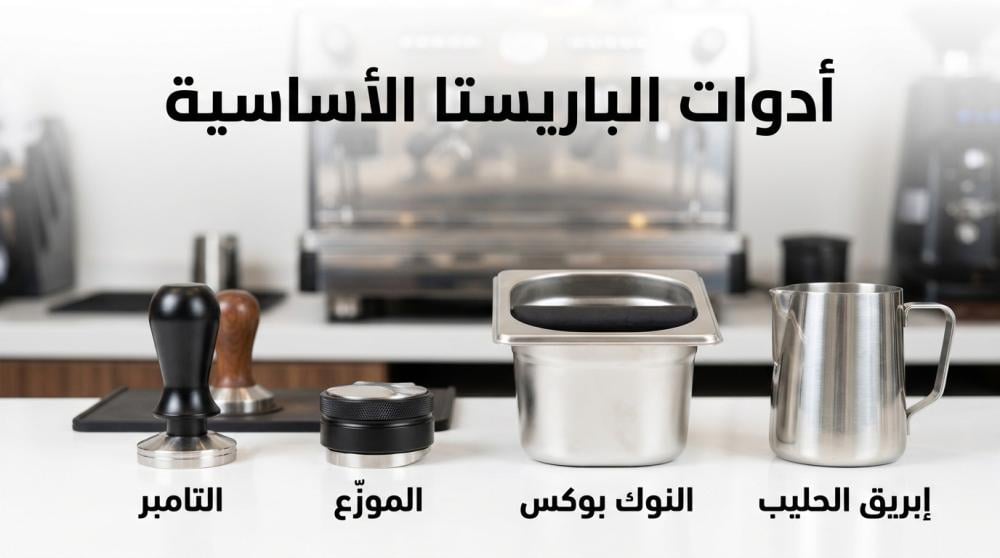
A professional barista relies on a small set of tools placed on the table, each piece solving a specific problem: uneven pressure, random distribution, messy emptying of used coffee grounds, or rough milk foam. These four tools are the tamper, dispenser, knuckle box, and milk jug .
Why do barista tools matter?
Espresso preparation relies on forcing hot water under high pressure through a layer of pressurized coffee grounds. If this layer is uneven, the water finds the easiest path and passes through it, creating what is called channeling . This results in some parts of the coffee being extracted too much and others too little, leading to a coffee that combines bitterness and acidity.
The tools we are talking about aim to reduce this problem and give you consistent and frequent results, saving you money and making work easier, especially in busy cafes.
First: The Tamper
What is it?
The tamper is a tool with a handle and a flat base, used to compress ground coffee inside the portafilter basket evenly and firmly, so that the surface is level and firm.
Why isn't the included plastic tamper enough?
The tamper included with some machines is lightweight and often doesn't perfectly match the basket's dimensions, leaving gaps at the edges that allow water to leak. A good, independent tamper, however, provides the right weight and a more accurate sense of pressure.
How do you choose the right tamper?
- Size: The most common size is 58 mm, which is the most widely used in professional machines. Other sizes are available, such as 51 mm and 53 mm, so be sure to check the diameter of your basket before purchasing.
- Base: Flat bases are the most common, but curved bases are preferred by some professionals.
- The handle: Choose what is comfortable for your hand, made of wood, aluminum, or stainless steel.
- Weight and balance: A balanced tamper helps you to squeeze more evenly.
Usage tips
- Press down on a stable surface and keep your wrist straight.
- Press firmly and comfortably; the most important thing is evenness , not excessive pressure.
- Make sure the surface is perfectly horizontal before installing the portafilter.
- Clean the edges of the basket of any scattered coffee grounds.
Second: The Distributor
What is it?
A distributor is a tool that is rotated over the coffee grounds after grinding to level the surface and distribute the particles evenly inside the basket before pressing. Some have blades, flat surfaces, or a spiral shape.
Why does it matter?
Coffee grounds that fall from the grinder often accumulate on one side of the basket, forming a small mound. If you press down on it like this, the density of the layer varies from place to place, causing water to leak from the weakest areas. The distributor addresses this problem before it even begins.
Distributor or WDT technology?
There's a simple technique called WDT that uses fine needles to break up clumps and even out the coffee. Many baristas combine the two tools: needles to break up clumps, then a distributor to level the surface. This is especially suitable when using finely ground coffee.
Usage tips
- Adjust the depth of the dispenser so that it gently touches the surface of the coffee beans.
- Turn it gently without applying excessive pressure.
- Choose a dispenser that matches the size of your basket for the best fit.
Third: Knock Box
What is it?
A knockbox is a container specifically designed for emptying used coffee grounds (cake) after each drink. It has a metal or rubber bar at the top that is struck against the basket to empty it.
Why don't we just use a trash can?
Emptying used coffee grounds into a regular basket is messy and can damage the basket and portafilter because you're hitting them against an unsuitable edge. The Knockbox, on the other hand, is designed to absorb these impacts gently, keeps your workstation clean, and saves time during peak hours.
How do you choose a Knock Box?
- Capacity: At home, a small size is sufficient, but at a cafe, choose a larger capacity that can hold dozens of cups.
- Material: Stainless steel is more durable and easier to clean, and there are heavy-duty plastic options as well.
- The rod: It is preferable that it be covered with a rubber layer to absorb shocks.
- Easy to clean: A removable drawer or container saves you the effort.
Fourth: Milk Pitcher
What is it?
A milk jug is a stainless steel vessel with a pointed spout, designed for steaming and pouring milk. Its shape is not arbitrary; the spout helps you control the flow of milk, which is important in creating latte art.
How do you choose the right size?
- 350 ml: Suitable for beginners and for one or two drinks.
- 600 ml: The most common size for everyday use, suitable for multiple drinks.
- 900ml and above: For cafes and large quantities.
As a general rule, fill the jug to about half full or slightly less, because milk expands during evaporation.
What should you pay attention to?
- Nozzle: A sharp nozzle is more suitable for drawing details, and a wider nozzle is more suitable for beginners.
- Handle: Choose a handle that is as comfortable and insulated as possible.
- Weight of the jug: A lighter jug is easier to stir.
- Cleaning: Clean the jug after each use and wipe away any milk residue immediately.
Tips for successful steaming
- Start with cold milk, and a cold pitcher if possible.
- Place the end of the steam wand near the surface of the milk at first to introduce air, then lower it to create the vortex.
- Stop when the kettle is warm enough to hold your hand, without reaching boiling point.
- Move the jug and tap it gently to remove large bubbles.
Additional tools complete the kit
After the four basic tools, you can consider these additions:
- Coffee scale: To control the dose and the resulting beverage.
- Tamper mat: To protect the work surface and stabilize the portafilter during pressing.
- Cleaning brush: To remove coffee residue from the grinder and head.
- Barista towels: To clean the steam wand immediately after use.
- Special cups: for serving drinks in the appropriate manner.
Coffee luxury: Your complete kit starts here
Whether you're setting up your coffee corner at home or opening a new cafe, Coffee Luxury confidently offers you the barista essentials you need, from tampers, dispensers, knock boxes, and milk jugs in multiple sizes, to the rest of the tools that complete the brewing experience.
We help you choose the right size for your machine and your usage, so you can start with tools that last and give you better results. On our blog, you'll find practical guides to help you develop your skills step by step.
Frequently asked questions about barista tools
What are the most important barista tools for beginners?
The tamper should be the right size for the basket, milk jug, and coffee scale. Then you can add the dispenser and knockbox over time.
What size tamper do I need?
It depends on the diameter of the portafilter basket in your machine. The most common size is 58 mm, but some machines use 51 or 53 mm, so measure your basket or consult your machine's manual.
Is a distributor necessary?
It is not essential, but it helps you achieve an even surface and reduce channel spacing, and is especially useful for beginners and those who want more consistent results.
What is the difference between a distributor and a tamper?
The distributor evens out and distributes the coffee grounds before pressing, while the tamper presses and compacts them. Each has a different function.
What is a Knock Box and why do I need it?
It is a box for emptying used coffee grounds from the basket after each drink, keeping the workplace clean and protecting tools from damage.
What size milk jug is suitable for home use?
The 350ml size is suitable for one or two drinks, and the 600ml size is more flexible for everyday use.
Why shouldn't I fill the milk jug completely?
Because milk expands and increases in volume during evaporation, if you fill the jug too full it will overflow or you won't be able to create a good vortex.
Can any pitcher be used to steam milk?
You can try that, but pitchers with their spout and shape give you better control over foaming and pouring.
What is the best material for barista tools?
Stainless steel is the most popular due to its durability and ease of cleaning, and it is suitable for tampers, jugs, and knock boxes.
Where can I buy barista tools in Saudi Arabia?
You can find them in specialty coffee supply stores, including Luxury Coffee , which offers a variety suitable for home and cafe.
You don't need dozens of tools to get started, but the right tools make a noticeable difference in every cup. A tamper for even pressure, a spreader for a smooth surface, a knockbox for a clean work surface, and a milk jug for smooth foam. Start with what works for you, then upgrade your set as your skills develop.