
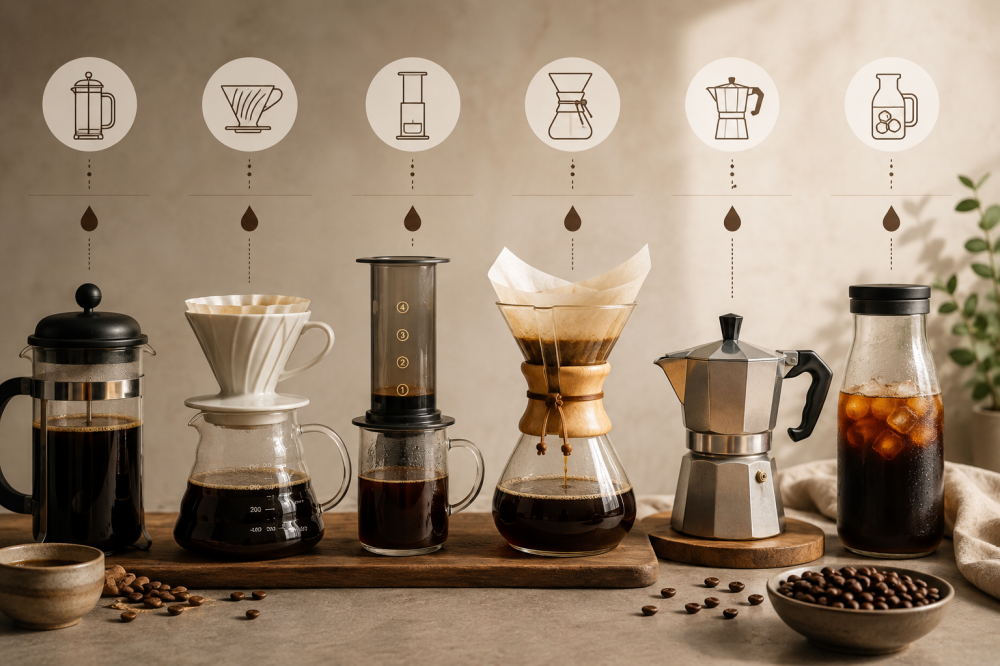
Imagine using the same coffee beans, the same grinder, and the same brewing equipment, yet each time you get a different cup. Sometimes it's so strong that your mouth feels full of coffee, sometimes it's so weak as if you added too much water, and sometimes the flavor is so perfectly balanced that you wonder: what did I do right this time? The answer might be simpler than you think: the ratio of water to coffee.
Coffee isn't just beans and water; it's a delicate equation. Changing the amount of water, even slightly, can alter the strength of the brew, while changing the amount of coffee affects the intensity of the flavor and the body. The problem is that the coffee-to-water ratio isn't the same for all brewing methods .
The ratio that suits V60 is not necessarily the best for Chemex, and what suits French press is completely different from espresso.
In this guide from Coffee Luxury , we will learn the best starting point for the coffee-to-water ratio in the most popular coffee preparation methods, how to choose the right ratio, when to add more water or coffee, and how to achieve a balanced cup that suits your taste.
What is meant by the coffee-to-water ratio?
The coffee-to-water ratio is the relationship between the weight of coffee used and the weight of water used in preparation.
For example, when we say:
1:15
This means using 1 gram of coffee for every 15 grams of water .
If you used 20 grams of coffee:
20 x 15 = 300 grams of water
Similarly, a 1:16 ratio means that every gram of coffee corresponds to 16 grams of water.
This does not mean that a 1:15 ratio is always better than a 1:17 ratio; the choice depends on the method of preparation, the type of coffee, the grind, and the result you want.
Why is the coffee-to-water ratio important?
Because it greatly influences the concentration of the drink .
When you use less water, the coffee becomes more concentrated, while increasing the water results in a lighter beverage.
But focus is not the only factor.
Grinding, water temperature, contact time, and pouring method all affect the amount of compounds that water extracts from coffee.
Therefore, it is best to treat the ratio as a fixed starting point , and then use taste to determine the appropriate adjustments.
Coffee to water ratio in V60
V60 is one of the methods of drip coffee in which the effect of the ratio is most clearly evident.
You can start with a percentage:
1:15 to 1:17
Some of the most common practical starting points are:
20 grams of coffee + 300 grams of water
That is, at a ratio of 1:15 .
If you prefer a more concentrated cup, a ratio closer to 1:15 can be used.
If you prefer a lighter, more open cup, you can try 1:16 or 1:17.
Example of a V60 recipe
- 20 grams of coffee.
- 300 grams of water.
- A medium grind suitable for distillation.
- Water at a temperature suitable for the type of roasting.
- Extraction time depends on the tool, coffee beans, grinding, and pouring method.
If the cup is too concentrated, try increasing the amount of water.
If it's too light and watery, reduce the water or increase the amount of coffee.
But do not change the ratio and the grinding at the same time, until you know the reason for the change in the result.
Coffee to water ratio in Chemex
Chemex requires a relatively larger quantity of water when preparing several cups, while maintaining a constant ratio as much as possible.
You can start with a percentage:
1:15 to 1:17
example:
30 grams of coffee + 450 grams of water = 1:15
or:
30 grams of coffee + 510 grams of water = 1:17
The Chemex features a thick paper filter that helps produce a clean cup with minimal sediment, so floral and fruity flavors can be pronounced when using suitable coffee.
Coffee to water ratio in Kalita Wave
The starting point in Kalita is similar to many hand-distilling recipes.
You can try:
1:15 to 1:17
Practical example:
20 grams of coffee + 300 grams of water
Then adjust the ratio based on taste.
If the coffee is too strong or heavy, add a little more water.
If it's weak, reduce the water or increase the coffee dose.
It should be noted that the ratio alone does not determine the result; the shape of the flat base, the filter, and the method of casting and grinding all play a role.
Coffee to water ratio in French press
The French press is different from the dripping methods because the coffee is soaked in water for a period of time and then separated by the press.
One can start with a percentage of approximation:
1:12 to 1:17
For a rich and balanced cup, you can try:
30 grams of coffee + 450 grams of water
Any ratio:
1:15
If you find the coffee is too strong, you can add more water.
If it's weak, you may need to reduce the water or increase the dose of coffee.
It is important not to grind the coffee too finely; the French press usually needs a coarser grind than V60.
Coffee to water ratio in AeroPress
AeroPress is one of the most versatile tools, therefore there is no single ratio that can be considered the only correct recipe.
Recipes can range approximately between 1:10 and 1:16 , depending on the amount of water used inside the tool, the soaking time, the degree of grinding, and whether you add water after pressing.
For example, one could try:
15 grams of coffee + 200 grams of water
Then adjust the recipe according to taste.
If you want a more concentrated drink, you can reduce the amount of water.
If you want a lighter cup, you can increase the water or add water after extraction.
This is where AeroPress's advantage comes in: its ability to give you more than one style using the same tool.
Coffee to water ratio for espresso
Espresso is a different case; because we don't usually talk about the ratio of coffee to the water used for full preparation, as in V60, but rather about the ratio of the dose to the weight of the resulting beverage.
This relationship is called the Brew Ratio .
Some of the most common starting points:
1:2
any:
18 grams of coffee → approximately 36 grams of espresso
However, some recipes may use 1:1.5 for a more concentrated espresso, or 1:2.5 for a lighter, more extended drink.
How do you determine the correct ratio for espresso?
watch:
- Dose weight.
- Weight of the beverage.
- Extraction time.
- Grinding degree.
- The final taste.
If your espresso is sour and weak, you may need to adjust the grind or extraction ratio.
If it is bitter and dry, you may need to reduce the extraction or change the milling.
Coffee to water ratio in V60 cold
If you are a fan of iced coffee, you can't count hot water alone.
Ice is part of the final drink equation.
For example, you could start with:
20 grams of coffee + 120 grams of hot water + 120 grams of ice
This means that the total weight of water and ice is 240 grams .
This method is distinguished by the fact that it produces cold coffee immediately after distillation, instead of preparing hot coffee and then putting it in the refrigerator.
If the result is too diluted, reduce the ice or increase the coffee concentration.
What happens if the amount of water increases?
When you increase the water while keeping the amount of coffee constant, you get a less concentrated drink.
But there is a difference between:
Light and balanced coffee, and weak coffee due to insufficient extraction.
The drink may be light because you used a high water ratio, or it may be light because the grind was too coarse or the contact time was too short.
Therefore, not every problem is solved by increasing coffee intake.
Start by tasting and asking:
Is the coffee only light?
Or is it also sour and sharp?
If it's light and balanced, you probably just need to increase your concentration.
If it is sour and weak, the grinding or extraction method may need to be modified.
What happens if the amount of coffee increases?
Increasing the coffee while keeping the amount of water constant means a more concentrated drink.
But using a large quantity of coffee does not automatically mean getting better coffee.
If the extraction method is not changed in proportion to the dosage, you may get an unbalanced extraction.
Therefore, a clear ratio should be maintained instead of adding coffee randomly.
How do you choose the ratio according to your taste?
The choice can be broken down in a simple way:
If you like strong coffee
Start with a ratio closer to:
1:15
If you like balanced coffee
Start with a percentage:
1:16
If you like light coffee
try:
1:17
But remember, this is just a starting point.
The type of coffee beans, the degree of roasting and grinding, the pouring method, and the quality of the water can all change the result.
Is the coffee-to-water ratio more important than the degree of grinding?
The two cannot be separated. You can use a perfect ratio, but if the grinding is not suitable, you will not get the desired result.
For example, you might use V60 at a ratio of 1:16, but grinding too coarsely makes the water pass through too quickly, resulting in an under-extracted cup.
The same ratio may be used with very fine grinding, resulting in a slower flow and increased extraction.
Therefore, when adjusting the coffee recipe, keep the ratio constant first, then gradually adjust the grind.
The role of water quality in coffee taste
Water is not a neutral element.
It makes up the largest proportion of the final beverage, and therefore its mineral properties affect the water's ability to extract compounds from the coffee.
The wrong water can ruin the coffee:
- Dull.
- time.
- Sharp.
- It has a weak flavor.
- Less obvious.
Therefore, it is preferable to use clean, balanced, and suitable water for preparing specialty coffee.
Why should a scale be used?
If you rely solely on spoons and cups, it is difficult to replicate the recipe.
The scale allows you to measure:
- Weight of coffee.
- Quantity of water.
- Quantity of ice.
- Weight of the espresso dispensed.
- And sometimes the preparation time if the scale is equipped with a timer.
This transforms coffee preparation from a random experiment into a recipe that can be repeated and modified.
How do you adjust your recipe step by step?
Instead of changing everything at once, follow this method:
First: Choose the quantity of coffee beans.
Second: Determine the ratio of coffee to water.
Third: Keep the water temperature constant.
Fourth: Adjust the grind setting.
Fifth: Prepare the recipe.
Sixth: Tasting the coffee.
Seventh: Change only one factor.
If the coffee is too strong, try adding more water.
If it's too thin, reduce the water.
If it's sour and weak, try a finer grind.
If it's bitter and dry, try a coarser grind or reduce the extraction.
This way you will know exactly what led to the improvement in the result.
Coffee preparation supplies from the luxury of coffee
A good recipe needs tools to help you execute it accurately.
At Coffee Luxury you will find a range of specialty coffee supplies suitable for coffee lovers and cafes in Saudi Arabia, from coffee grinders, V60 tools and drip filters to scales, kettles and various beverage preparation tools.
Choosing the right tools not only makes the coffee more professional, but it also helps you repeat the same recipe every time, whether you're making a V60 at home, or running a specialty coffee station inside a cafe.
Start with a good scale, a grinder that gives you precise control over the grind, and a suitable brewing tool, then experiment with different ratios until you find the recipe that suits the coffee you love.
Frequently asked questions about the coffee-to-water ratio
What is the best ratio of coffee to water?
There is no single ratio that suits all brewing methods. You can start with a 1:15 to 1:17 ratio for drip coffee, then adjust it according to taste and the type of coffee beans.
How many grams of coffee are in 300 ml of water?
When using a 1:15 ratio, you need about 20 grams of coffee for every 300 grams of water.
What is the coffee-to-water ratio in a V60?
You can start with a ratio of 1:15, 1:16 or 1:17. A practical recipe is 20 grams of coffee with 300 grams of water.
How many grams of coffee are in a cup?
This depends on the size of the cup and the method of preparation, but you can start with about 15–20 grams for drip coffee, then adjust the quantity according to the size of the drink and the required ratio.
What is the coffee-to-water ratio in French press?
You can start with a ratio of approximately 1:15, such as 30 grams of coffee with 450 grams of water, and then adjust it according to the strength of the drink required.
What is the coffee-to-water ratio in Chemex?
You can start with a ratio of 1:15 to 1:17. For example, 30 grams of coffee with 450–510 grams of water.
What is the ratio of coffee to water in espresso?
It varies depending on the recipe, but a 1:2 ratio is a common starting point; for example, using 18 grams of coffee to produce about 36 grams of espresso.
Does adding more water make coffee stronger?
No, increasing the water while keeping the amount of coffee constant makes the drink less concentrated, while decreasing the water makes it more concentrated.
Why is the coffee bitter even though the ratio of coffee to water is correct?
The reason could be excessively fine grinding, a long extraction time, high water temperature, or other factors. The ratio alone does not determine the taste.
Should water be weighed when preparing coffee?
Yes, it is preferable to weigh the water to obtain an accurate and repeatable recipe, especially when preparing specialty coffee.
Does the ratio of coffee to water vary depending on the type of coffee bean?
Yes. The type of coffee, the degree of roasting and grinding, and the method of preparation all affect the appropriate ratio, so it is best to consider the ratio as a starting point and not a fixed rule.
What is the best ratio for specialty coffee?
It depends on the brewing method and taste. For drip coffee, you can often start with a ratio of 1:15 to 1:17, then adjust the ratio based on taste.
Is the coffee-to-water ratio more important than the type of grinder?
Both are important. The ratio determines the concentration of the formula, while the mill affects the particle size, uniformity, and extraction speed. For consistent results, you need both.