
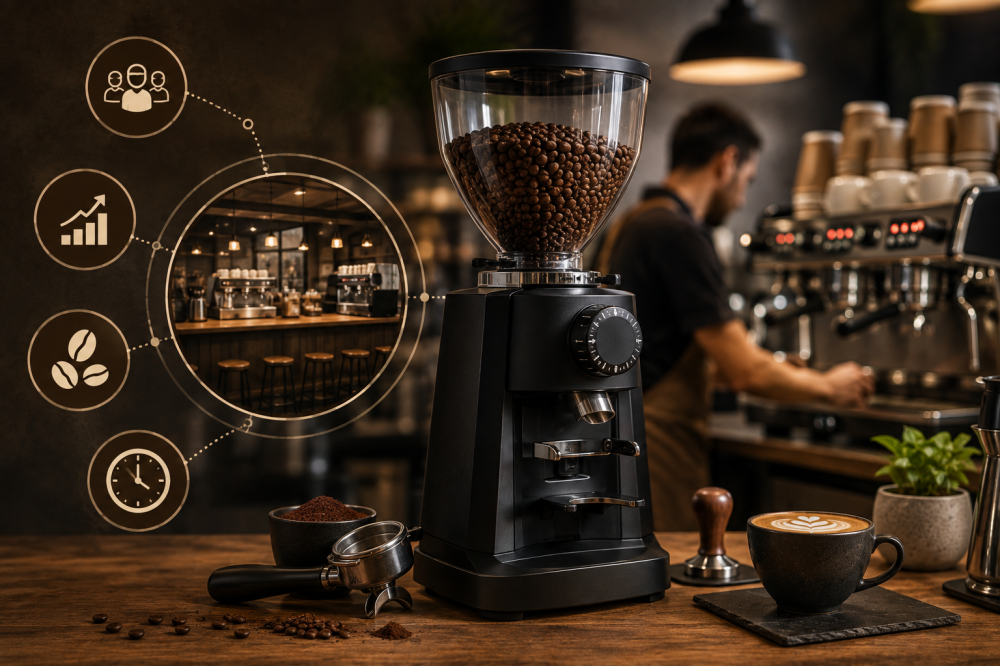
The coffee grinder directly affects the speed at which water passes through the coffee pellet, and therefore the sweetness, acidity, body, and bitterness. It also affects the time the barista needs to prepare each drink.
When the grinder is slower than the espresso machine, the team waits for the grinder to complete instead of utilizing all available groups. If the dosages are inconsistent, the barista has to weigh, adjust, and discard extra doses, increasing waste and slowing down service.
Therefore, a professional espresso grinder should be treated as an essential part of the cafe's operational capacity, not a secondary accessory alongside the machine.
Start by calculating peak order pressure
Don't rely solely on the total number of cups a cafe sells during the day. Two cafes might offer the same number of drinks, but one spreads out its orders over many hours, while the other receives most of them during a short morning period.
The most important criterion is the number of espresso drinks the team needs to prepare during the busiest working hours.
Review the sales data and identify:
- Number of orders during peak period.
- Percentage of drinks that are based on espresso.
- Number of single and double doses.
- The number of groups available in the coffee machine.
- The number of baristas working at the same time.
- Size of external orders and delivery.
- The presence of seasons or promotions that boost sales.
Then choose a mill that can meet this pressure with some room for growth, rather than buying a mill that will operate at its maximum capacity from day one.
Pay attention to the actual grinding speed.
Grinding speed typically refers to the amount of coffee a grinder can grind in a given time. The faster the speed, the shorter the barista's waiting time between orders.
However, the grinder should not be chosen based solely on the highest number; because the speed must come with a stable particle size and the coffee temperature not rising to a level that affects the flavor.
Some companies compare the speed of professional espresso grinders to the number of grams they grind per second, and the speed may vary depending on the fineness of the grind, the type of beans, and the degree of roasting.
Therefore, test the time your grinder takes to produce the actual serving size in your café, then compare that to the number of orders and groups. A grinder that takes too long per serving could disrupt a multi-group espresso machine, even if the grind quality is good.
What is the importance of the size of the grinder blades?
Professional coffee grinders use burrs or grinding discs of varying sizes and designs. The size of the burrs affects the grinding speed and the grinder's ability to withstand frequent use.
Larger blades typically help grind more in less time and distribute the work over a wider area. This is why larger sizes are common in coffee shop grinders with high consumption, while smaller sizes are sufficient for smaller projects or for grinding a by-product.
Many commercial espresso grinders use flat burrs because they produce a more uniform particle distribution, which is crucial for consistent espresso extraction. However, burr size alone does not determine grinder quality; the motor must also be compatible and capable of operating under continuous load.
Therefore, do not buy a grinder just because its blades are large, but compare the blade size, grinding speed, motor power, cooling system, and operating power recommended by the manufacturer.
Choose an engine designed for commercial use.
A home grinder may have good blades and produce acceptable espresso, but it is not necessarily designed for frequent use throughout the day.
In a coffee grinder, the motor needs to withstand continuous operation without slowing down, stopping, or overheating. It must also provide adequate torque for grinding light, medium, and dark grains at precise grind settings.
Manufacturers emphasize that the motor must be precisely matched to the blade size and torque requirements in different grinding conditions.
Ask the supplier about the recommended use of the grinder, its ability to handle working pressure, and its heat protection system, and do not assume that higher wattage alone means better performance.
Observe the effect of heat on grinding.
The grinding process produces heat due to the friction of the grains against the blades, and the temperature of the mill may rise when successive doses are carried out during peak hours.
Heat can affect the behavior of the coffee beans and the speed of extraction, forcing the barista to adjust the grind level more than once during the day.
Therefore, some commercial mills use ventilation or temperature control systems for the motor and grinding area, with the aim of maintaining more stable performance.
When comparing mills, check their ability to operate continuously, the location of the ventilation openings, the ease of heat dissipation, and whether the company recommends them for medium or high consumption.
The grinder should also be installed in a well-ventilated space, and not placed next to a strong heat source or inside a closed corner.
Choose a dosage system that suits your work style.
Espresso grinders are available with different dose-determining systems, the most common of which are time-based grinding and weight-based grinding.
Grinding by time
The grinder grinds for a predetermined time. This system is fast and easy to use, but slight variations in dose weight may occur depending on the bean level in the hopper, the type of coffee, or the grind setting.
This variance can be reduced through daily calibration and regular dose weight review.
Grinding by weight
The grinder uses a built-in scale to stop grinding when the target weight is reached. This helps improve dosage accuracy and reduces the time baristas spend weighing and correcting.
Some modern commercial mills offer direct weight-based dose measurement, with weight tracking technologies during milling to achieve the target with high accuracy.
This system is useful in busy cafes that need greater stability and less waste, but it may increase the cost of purchasing the grinder and requires proper cleaning and calibration.
Make sure the grind setting is easy to adjust.
The required grind size changes due to humidity, heat, coffee freshness, and crop variations, so the barista needs to adjust the grinder throughout the day.
Choose a grinder that allows for precise and smooth adjustments without large jumps between settings. Fine or infinitely adjustable settings are best suited for espresso preparation because they give the barista greater control over achieving the desired extraction time.
However, the control dial must be clear and stable, so that the settings are not changed by mistake during cleaning or use.
It is also preferable to train a limited number of team members on calibrating the grinder and recording the basic recipe for each type of coffee bean.
Pay attention to dosage consistency and coffee retention.
Coffee retention refers to the amount of ground coffee that remains inside the grinder track after the dose is finished.
When retention is high, residues from a previous grind may be present in the next brew, especially after adjusting the grind size or changing the type of coffee. This can affect freshness, weight accuracy, and extraction speed.
Some mills advertise systems that reduce coffee grounds, clumping, and static electricity, which helps the coffee to come out cleaner and more evenly.
In a high-demand coffee shop, the small amount of retention may not be noticeable due to the speed of the grain rotation, but it becomes important when using a mill for a seasonal crop or slow-moving decaffeinated coffee.
Choose an appropriate hopper capacity without exaggeration.
A larger hopper helps reduce the number of times the grinder needs to be refilled during order rushes, but bigger isn't always better.
If consumption is low, the grain may remain inside the hopper for an extended period, exposed to air, light, and the mill's heat. Therefore, a capacity should be selected that corresponds to the actual consumption rate.
It is preferable to put in enough operating quantity for the short period, then refill as needed, instead of using the hopper as a coffee storage container for the whole day.
It is also important to ensure that the hopper can be easily removed, its gate closed, and cleaned, especially when changing crops or performing daily maintenance.
Do you need one grinder or more?
A single espresso grinder might suffice for a small café with a basic blend and limited order volume. However, relying on a single grinder in a high-selling business could pose an operational risk.
A cafe may need an additional grinder in the following cases:
- Having a basic espresso blend and another crop.
- Serving decaffeinated coffee.
- High demand over a short period.
- Operating a multi-group espresso machine.
- The need for a replacement when cleaning or in case of a breakdown.
- Coffee recipes vary between drinks.
In some projects, the second, smaller mill is dedicated to decaf or seasonal crops, while the larger commercial mill handles the basic mix.
Do not use one grinder for all preparation methods without studying
The grind setting for espresso differs from that for drip coffee and cold brew. Constantly switching between different grind settings wastes coffee grounds and time, and it can be difficult to quickly return to the correct espresso preparation.
If the cafe offers a high volume of drip coffee, it is often best to allocate a separate grinder for it.
Multi-purpose mills are suitable when the demand for the second method is limited, and the grinding change mechanism is easy and repeatable.
Choose the function of each grinder before purchasing, and do not base the decision on the idea that one device must perform all tasks regardless of the operating pressure.
Check out the ease of cleaning and maintenance
Coffee oils and grinding residue accumulate inside the hopper, blades, and outlet. Over time, this can affect flavor, grinding speed, and dose consistency.
Therefore, the grinder should allow for cleaning the hopper and coffee outlet and access to permitted parts without complicated procedures.
In medium and high-volume cafes, specialized guidelines recommend cleaning the grinding track frequently, and daily cleaning may be necessary depending on the volume of work and the type of coffee.
Before purchasing, inquire about the availability of blades and spare parts, maintenance services, warranty period, and the availability of a technician familiar with the model. A high-quality grinder that is difficult to repair can lead to prolonged downtime and lost sales.
Consider the noise and bar area
The grinder operates close to customers and staff, and its noise can become annoying if the cafe is small or has an open design.
Some mills offer systems to reduce noise and vibration, which is a useful feature but should not come at the expense of operating power.
Also check the height of the grinder with the hopper, the space available under the cabinets, the location of the electrical outlet, and the ease of movement for the barista between the grinder and the machine.
The portafilter holder must be practical and allow grinding without constant holding if the operating system is hands-free.
Common mistakes when buying a coffee grinder for a cafe
One of the most common mistakes is buying a home grinder for a business project with the aim of reducing costs, or choosing a grinder based on motor power alone.
Mistakes also include ignoring the number of orders during peak times, purchasing a huge hopper that is not proportional to consumption, using one grinder for espresso, drip and decaf, and not checking the availability of maintenance and spare parts.
Another mistake is buying a mill that has been operating at full capacity since the project's opening, without leaving room for increased sales or adding delivery services.
Price is important, but the cost of downtime, waste, and slow service may be greater than the price difference between a limited-purpose mill and one designed for commercial use.
How do you test a grinder before certifying it?
Test the grinder using the coffee beans that the cafe will rely on, and monitor its performance over several consecutive doses, not just one dose.
Check the grinding speed, the uniformity of the coffee output, the weight of the doses, the amount of clumps, the ease of adjusting the grind, and the sound and heat levels.
Next, prepare several consecutive espresso shots and compare the extraction time and taste. Also, calculate the total time from attaching the portafilter until the grinding is complete, not just the blade rotation speed.
If the project is in place, the mill can be tested during a period that simulates actual order pressure before a final purchase decision is made.
Choose your coffee grinder from the luxury of coffee
Coffee Luxury offers a range of professional coffee grinders suitable for cafes in Saudi Arabia, from grinders designed for small and medium-scale projects, to commercial grinders designed to withstand high demand.
The store also provides espresso machines, specialty coffee beans, barista tools, grinder cleaning materials, as well as cafe setup, maintenance and support services in selecting the right equipment.
You can compare grinders based on grinding speed, blade size, dosing system, hopper capacity, and menu type, instead of buying a device that is not suitable for the size of your project.
Choose your coffee shop equipment from Coffee Luxury, and take advantage of the specialist expertise to get a grinder that will help your team deliver faster, more consistent doses during peak hours.
Summary
Choosing the best commercial coffee grinder doesn't start with the brand name or the price of the machine, but with analyzing order pressure and how the bar is operated.
Determine the number of doses required at peak time, then compare the grinding speed, blade size, motor power, cooling system, dosing accuracy, and ease of adjustment and cleaning.
Choose a grinder that has room for growth, and for which maintenance and spare parts are available, and don't make the barista or espresso machine wait for the grinding to finish.
The right grinder reduces waste, speeds up service, maintains espresso quality, and helps the cafe handle increased orders without sacrificing the consistency of each cup.
Frequently asked questions about choosing a coffee grinder for a cafe
What is the best coffee grinder for a cafe?
It is the grinder that suits the number of doses required at peak times, and provides consistent and fast grinding with easy adjustment, cleaning and maintenance availability.
Is a home coffee grinder suitable for a cafe?
They are often not suitable for continuous commercial operation; because they may overheat or slow down and are not designed to produce successive doses throughout the day.
What is the appropriate size for the grinder blades?
It depends on the size of the order. Larger blades usually help to increase grinding speed, but this should be evaluated in conjunction with the motor, cooling system, and operating power.
Which is better: grinding by time or by weight?
Time-based grinding is usually faster and less expensive, while weight-based grinding provides greater accuracy in dosing and helps reduce waste.
Are flat blades suitable for espresso?
Yes, it is widely used in commercial mills because of its ability to produce a homogeneous distribution that helps stabilize extraction.
Why does the grinder heat up?
This results from blade friction and repeated operation, and may increase with high demand, poor ventilation, or if the mill is not suitable for commercial use.
Does the cafe need two grinders?
They may be needed when demand is high or when decaf and seasonal crops are being offered, or to provide a replacement in case of cleaning or a break.
Can an espresso grinder be used for drip coffee?
It is possible in some mills, but the constant change between far-reaching grinding degrees consumes time and coffee, so it is preferable to dedicate a mill for distillation when demand for it is high.
What is meant by coffee grounds being trapped inside the grinder?
It is the amount of ground coffee that remains within the grinding path, and may affect the freshness and accuracy of the dose when changing the setting or type of coffee.
How do I know if the mill cannot withstand the work pressure?
Signs such as slow grinding, high temperature, varying dosages, changes in extraction time, or motor stopping during successive orders may appear.
How often should a coffee grinder be cleaned?
The hopper and coffee outlet should be cleaned regularly, with the grinding path cleaned according to usage size and manufacturer's instructions.
What is the most important thing to check before buying?
Make sure the grinder is designed for expected commercial use, and that maintenance, blades and spare parts are available within Saudi Arabia.