
If you read the description of a specialty coffee sachet and find: “Blueberry notes, cherry acidity, honeyed body, and a jasmine finish,” you read the line twice and honestly ask yourself: Is this coffee or a perfume list? This is exactly what happens to many beginners. They buy the most expensive or exotic sachet, drink it without understanding the hype, and then mistakenly conclude that specialty coffee isn't for them.
The problem isn't with you or the coffee itself, but with where you start. Specialty coffee is to be savored like any other food: don't begin with the most unusual, but with what teaches you the language. In this article, we recommend the first three coffees to begin your journey with, explaining why each is suitable for beginners and how you can confidently progress from there.
First: What is meant by crop?
The origin of a coffee is the region or country where the coffee beans were grown. Many factors influence this, including altitude, climate, soil, post-harvest processing methods, and the coffee variety itself. Therefore, Ethiopian coffee differs significantly from Colombian coffee, and both differ from Brazilian coffee in taste, acidity, and body.
Understanding crops is the fastest way to discover your taste. Instead of randomly trying dozens of varieties, try three crops that represent three different trends, and then you'll know where you're inclined.
How to choose a suitable crop for a beginner?
Before the names, these are the selection criteria:
- Balance: neither severe acidity nor strong bitterness.
- Clarity: Understandable flavors that are easy to associate with what you know, such as chocolate, nuts, and fruit.
- Variety in methods: It is well prepared with both espresso and drip coffee.
- Easy access: Available in roasters and reasonably priced.
- Tolerance for mistakes: It gives an acceptable cup even if the grinding and preparation are not perfect.
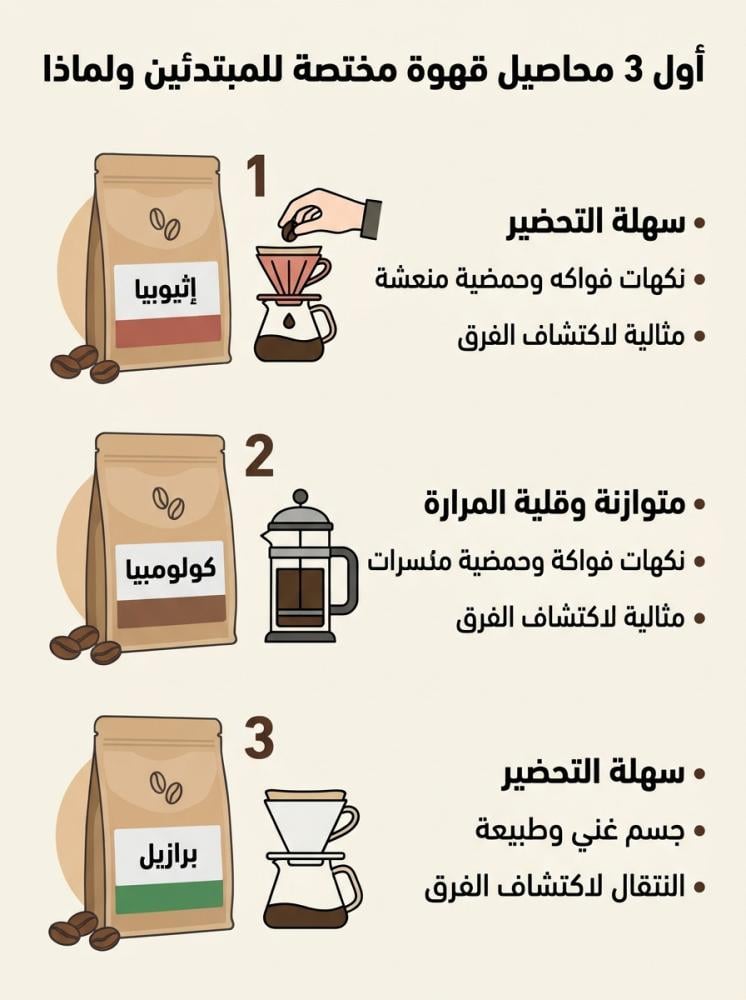
First crop: Brazil — the friend that never lets you down
Why is it suitable for beginners?
Brazil is the world's largest coffee producer, and its coffee is known for its balance, smoothness, and low acidity. If you're coming from the world of traditional or dark roast coffee, it's the closest point of transition to specialty coffee.
Expected flavors:
- Chocolate and nuts (almonds, hazelnuts, peanuts).
- Caramel and brown sugar.
- Full texture and mild acidity.
Best preparation methods:
- Espresso: One of the most famous bases for espresso blends, it gives the cream density and the body fullness.
- Coffee with milk: Its flavor is enhanced by the milk, making it suitable for lattes and cappuccinos.
- French press: Gives a full and comfortable cup.
Who is it suitable for? For those who love the familiar, comforting taste, for those who drink coffee with milk, and for those who are afraid of acidity.
The second crop: Colombia — the balance that introduces you to fruit
Why is it suitable for beginners?
Colombian coffee is one of the most versatile and well-balanced varieties. Its acidity is more pronounced than Brazilian, yet gentle, and it has a natural sweetness that places it somewhere between the familiar dark and the distinctively fruity. It's a good starting point for learning what good acidity looks like in coffee.
Expected flavors:
- Caramel and milk chocolate.
- Red apples, oranges, and light stone fruit.
- Mild, medium acidity and medium body.
Best preparation methods:
- Drip coffee (V60 and Chemex): The details are clearly visible.
- Espresso: gives a sweet and balanced cup.
- Aeropress: Flexible and adaptable.
Suitable for whom? For those who want to go further than Brazil without surprises, and for those who love coffee without milk and care about natural sweetness.
The third crop: Ethiopia — where the adventure begins
Why is it suitable for beginners?
Ethiopia is considered the birthplace of coffee, and its coffee is most distinguished by its floral and fruity notes. It's not "easy" in the traditional sense, but it opens your eyes to what coffee can be. Trying it after Brazil and Colombia provides a clear comparison that teaches you about taste.
Expected flavors:
- Flowers (jasmine, rose, chamomile).
- Berries, red fruits, and citrus fruits.
- More pronounced acidity, lighter body, and aromatic scent.
Important note: Ethiopian squash comes in roughly two varieties depending on the processing method. The washed squash produces a clean, floral, citrusy cup, while the natural (dried) squash produces a sweet, fruity cup with berry notes. Start with the washed squash if you're concerned about acidity, and try the natural squash once you're used to it.
Best preparation methods:
- Drip coffee (V60 and Kalita): The perfect way to bring out the aromas and details.
- Aeropress: Suitable for experimenting with different ratios.
Suitable for whom? For those who love curiosity and experimentation, and for those who have tasted Brazil and Colombia and want to know the other side of coffee.
Comparison Summary
crop
acidity
Body
Top Flavors
Most suitable for
Brazil
Low
Full
Chocolate, nuts, caramel
Espresso and coffee with milk
Colombia
Medium
middle
Caramel, apple, orange
Drip coffee and espresso
Ethiopia
higher
lighter
Flowers, berries, citrus
Drip coffee
How to taste coffee like a pro (even if you are a beginner)?
You don't need complicated tools. These simple steps will train your sense:
- Drink all three types in the same way so that you can compare the yield, not the preparation.
- Smell the coffee before drinking it, because the smell is half the experience.
- Sip with a voice so that the liquid spreads over your tongue and the flavors come out.
- Make notes: Is it sweet? Sour? Bitter? Do you remember a familiar taste?
- Pay attention to the aftertaste, as it reveals the quality of the coffee.
- Let the coffee cool down a little, as the flavors become more apparent when the temperature is lower.
Practical tips before buying
- Buy small bags (250 grams) to try more without waste.
- Check the roasting date, preferably recent.
- Choose a light to medium roast to bring out the flavor of the crop.
- Buy whole grains, and it's best if you have a grinder, because fresh grinding improves the quality of the cup.
- Read the bag label: the crop, processing, elevation, and flavors all tell you.
- Don't judge based on the first cup, as adjusting the grind and quantity can greatly change the result.
Why the luxury of coffee?
Luxury Coffee is a specialized store for coffee supplies, specialty coffee, and various beverages. We assist you on your journey from the very first cup, with a wide selection of beans, grinders, brewing equipment, and a team to guide you to the perfect choice for your taste and preferences.
Whether you're just starting out or looking for your next step, we offer everything you need from bean to cup in one place. Browse our selection via Visit the Coffee Luxury website and contact our team to help you choose your first crop.
Frequently Asked Questions
What is the best specialty coffee crop for beginners?
Brazil is an excellent choice to start with thanks to its balanced flavors and low acidity, followed by Colombia with its moderate acidity, and then Ethiopia for those who want to experience floral and fruity notes. It's best to try all three for comparison.
What is the difference between specialty coffee and regular coffee?
Specialty coffee is grown, processed, and roasted with greater care, rated highly on taste, and is often sold with crop and processing information. The result is clearer, cleaner flavor profiles, while regular coffee is less traceable and detailed.
Is specialty coffee sour?
Some of them do, yes, and that's normal. The acidity in specialty coffee isn't like vinegar; it has a fruity flavor. If you prefer lower acidity, start with Brazil and gradually increase.
Should I start with whole grains or ground grains?
Whole grains are best for flavor and freshness if you have a grinder. If you don't have one, buy a small amount ground according to your preparation method and consume it quickly.
Which preparation method is most suitable for a beginner?
Drip coffee (V60), French press, or Aeropress are suitable and easier methods to learn than espresso, and the flavor of the crop is clearly visible in them.
Is light roasting suitable for beginners?
Medium or light roasting is best, as it reveals the flavor of the crop without the bitterness of dark roasting. Some very light roasts may be too acidic for those unaccustomed to them.
How many crops do I try before I know my taste?
Three different crops are enough to define your general taste preference: comfort, balanced, or fruity. You can then gradually expand by experimenting with other crops and treatments.
Is specialty coffee more expensive? And is it worth it?
They are usually more expensive because their quality, traceability, and production care are higher. They are worth the price for those who appreciate flavor and experience, and you can start with small sachets to try without committing to a large quantity.