
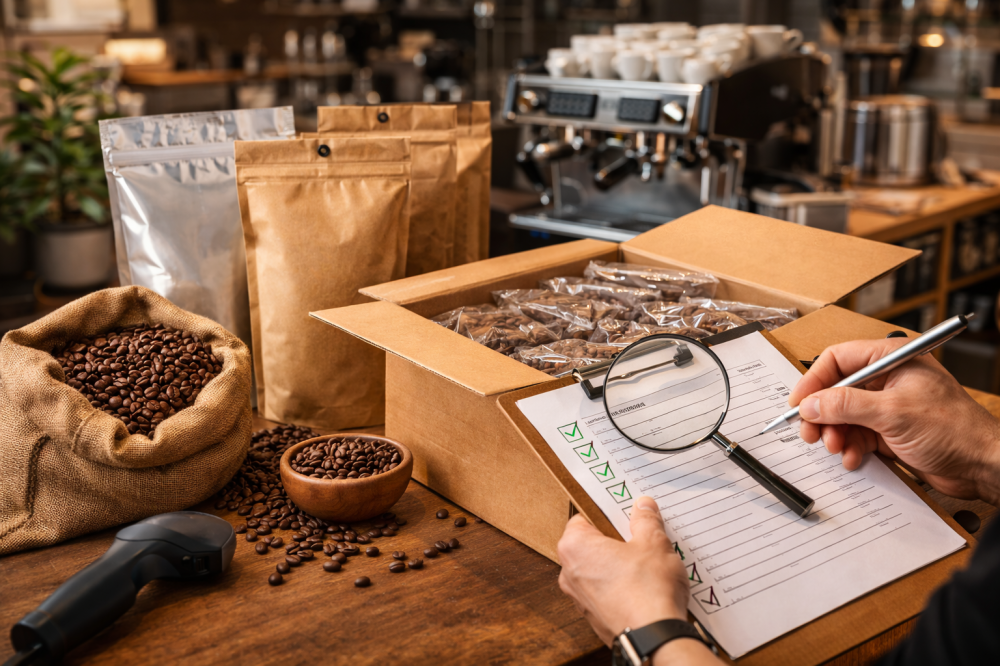
In Saudi Arabia’s rapidly growing specialty coffee market, receiving coffee beans is a crucial step that determines the quality of every cup your café serves. Whether you’re looking for a coffee bean receiving checklist , how to inspect coffee beans upon receipt , or a quality control checklist for coffee beans receipt , this article provides a complete, practical guide to help café owners and investors avoid losses and ensure freshness and flavor. With the rising costs of specialty beans, receiving a poor-quality batch can lead to significant financial waste and a loss of customer trust. Coffee Luxury , your premier consultant for establishing cafés and various coffee businesses, presents a comprehensive coffee bean receiving checklist based on SCA (Specialty Coffee Association) standards and global best practices adapted to the Saudi climate. We’ll cover visual inspection, documentation, physical quality, and post-receipt procedures, along with tips for maximizing profitability.
Why does your coffee shop need a coffee bean receiving checklist?
Coffee beans (whether green beans for roasters or roasted beans ready for cafes) are very sensitive to humidity, heat, light, and oxygen. In Saudi Arabia, where temperatures are high and humidity varies between regions, a batch can spoil within hours if not inspected immediately upon arrival.
Benefits of using a checklist:
- Prohibiting the acceptance of defective or non-compliant grains.
- Maintaining competent quality standards (80+ SCA points).
- Reducing waste and financial losses.
- Ensuring consistency in flavor for customers.
- Legal documentation in case of dispute with the supplier.
Coffee bean receiving checklist: detailed steps
Divide the inspection into time phases: before receipt, during receipt, and after receipt. Use a paper form or a digital form (Excel or an application) for recording.
1. Before the shipment arrives (preparation)
- Check the purchase order document against the price quote and specifications (origin, processing, degree of roasting, roasting date, quantity).
- Confirm the shipping date and arrival time.
- Prepare the testing equipment: a scale, a moisture meter, a UV light, size classification screens, samples for cupping, gloves, and a camera for documentation.
- Identify a responsible person (usually the barista manager or quality manager).
2. Check documents and papers upon arrival
- Compare the invoice/bill of lading with the order: quantity, net weight, supplier name, origin of grains (country, farm, crops).
- Check the roasting date : It should be within 7-14 days for roasted grains in cafes.
- Request a Certificate of Analysis (COA) if available: moisture content, water activity, number of defects.
- Record the lot/batch number for tracking.
Procedure : If the documents are not in conformity, do not accept the shipment until you have contacted the supplier.
3. Visual and external inspection of the shipment
- Check the pallet: Is it intact? No cracks, moisture, or damage to the plastic film.
- Check the number of bags: Does it match the documents? (Call them literally).
- Check the condition of the cysts:
- Clean, untorn, unwet, unstained.
- No strange smell (mold, chemicals, smoke).
- The markings are clear: supplier name, origin, weight, date.
- Look for signs of damage: insects, holes, dampness, mold, or oil leaks (in the toaster).
Tip : Photograph everything before opening any bag.
4. Physical inspection and internal quality (sample of several bags)
Open at least 3-5 bags at random (10% of the total quantity for large batches).
- Color and appearance :
- Green grains: uniform green-olive color, not pale or yellowish.
- Roasted grains: Consistent color according to the degree of roasting (light/medium/dark), no burnt or unroasted grains.
- Size and uniformity : Use sorting screens – the grains must be of uniform size for even extraction.
- Defects : According to SCA standards:
- Primary defects: None are acceptable (e.g., moldy, insect-infested, black grains).
- Secondary defects: Less than 5 complete defects in 350 grams of specialty coffee.
- Types of defects: broken, hollow, immature, insect-damaged, crystallized.
- Moisture Content :
- Ideal: 10-12% for green grains.
- Use a moisture meter – anything above 12.5% increases the risk of mold.
- Water Activity : Less than 0.60 for stability.
- The smell should be clean, fresh green (for greens) or strongly aromatic (for roasters). Avoid a leafy or sour smell.
- Examination under black light (UV) : Reveals mold or non-visible damage.
5. Sensory quality testing (Cupping or Tasting)
- Roast a small sample (if it is green) or prepare an espresso/brew from the roaster.
- Perform cupping according to the SCA protocol: dry aroma, after-pouring aroma, flavor, acidity, body, balance, aftertaste.
- Record the score: It must be 80+ for the specialist.
6. Procedures after examination
- If the test is successful: Transfer to the ideal storage area (cool, dark, dry, in vacuum containers).
- If it fails: Refuse the payment in whole or in part, notify the supplier immediately with photos and a report, and request compensation.
- Record everything: date, resource name, results, and the signature of the person in charge.
- Record in the inventory log to track FIFO (First In First Out).
Practical tips for implementing the checklist in Saudi cafes
- Train your team on the inspection (Coffee Wellbeing Courses).
- In the summer: Focus on humidity and immediate cooling.
- For small cafes: Start with a simple check (documents + visual + smell + taste).
- Use professional tools: moisture meter, Agtron for toast color, Fellow Atmos preserves.
- Monitor suppliers regularly: request samples before placing a large order.
- Linking the inspection to KPIs: Reduce the waste rate to less than 3%.
Common mistakes in receiving coffee beans (and how to avoid them)
- Failure to check before signing for receipt.
- Relying solely on trust without documentation.
- Immediate storage without moisture check.
- Ignore the minor flaws that affect the taste.
- Buying large quantities without prior samples.
Frequently asked questions about the coffee bean receiving checklist
1. What is the most important thing in checking the receipt of coffee beans?
Conformity between documents and reality + moisture and defect check.
2. Should each cyst be examined?
No, random samples are sufficient (3-10% depending on size), but examine the exterior of the whole.
3. What is the acceptable humidity level?
10-12% for green, and avoid anything above 12.5%.
4. How do I refuse a payment?
In writing, provide evidence (photos, measurements), and request a replacement or return.
5. Does the test differ between green and roasted grains?
Yes: The green ones need cupping after roasting a sample, and the roasted ones need immediate tasting and checking of the roasting date.
6. Where can I get testing equipment in Saudi Arabia?
From specialty stores such as Luxury Coffee.
7. How often should I check the inventory after receiving it?
Check weekly for freshness, and keep an eye on the roasting date.
Make the checklist an essential part of your operations.
Systematically implementing a coffee bean receiving checklist protects your café's quality and increases profitability by minimizing waste and ensuring customer satisfaction. Quality begins with receipt and doesn't end with serving. At Coffee Luxury , your specialty coffee and beverage supplier in Saudi Arabia, we are your premier consultant for setting up cafés and various coffee businesses . We offer not only the finest fresh coffee beans, vacuum storage containers, and quality control tools (moisture meters, V60 filters, roasting equipment), but also practical consultations on checklists, team training, and KPI optimization to maximize profitability.