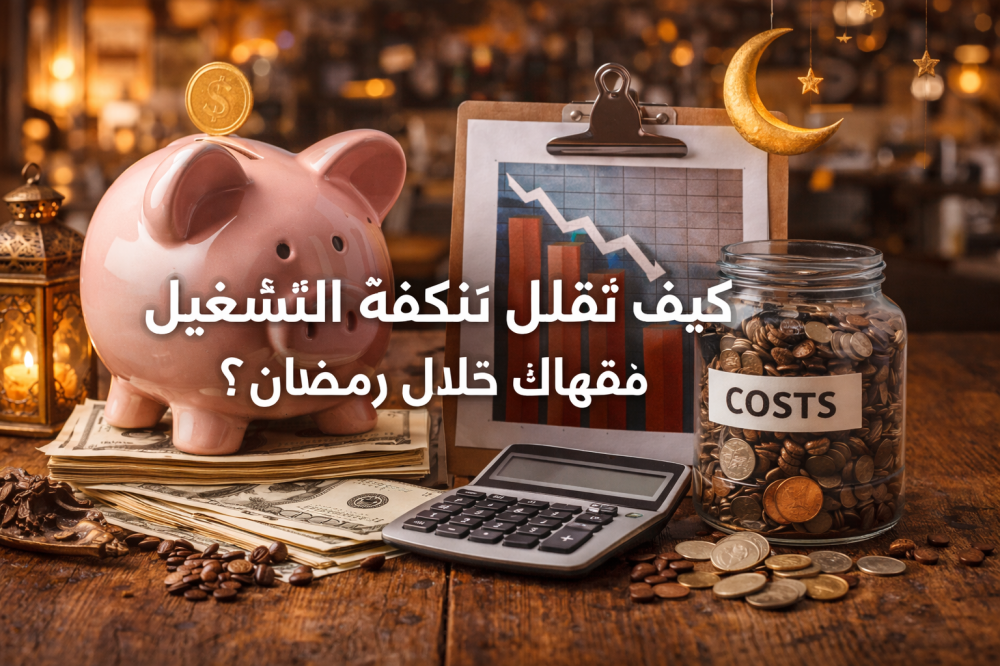
The holy month of Ramadan presents a golden opportunity for cafes in Saudi Arabia and the Arab world, as demand for coffee and hot beverages surges after Iftar and Taraweeh prayers, making cafes a favorite social gathering place for evening get-togethers. However, Ramadan also presents significant operational challenges: altered consumption patterns, concentrated demand during specific hours (after Iftar and before Suhoor), increased raw material costs, potential waste, and changes in work schedules. At the Coffee Luxury blog – specializing in coffee supplies, specialty coffee, and various beverages – we understand that success during Ramadan depends not only on increased sales but also on intelligently reducing operating costs without compromising service quality or customer satisfaction.
This article, specifically designed for café and coffee shop owners, presents seven proven strategies for reducing operating costs during Ramadan 2026, complete with real-world examples and immediately applicable tips. By implementing these points, you can save 15-30% on operating costs compared to normal operations and increase your profit margins during your most lucrative month.
1. Redesign the Ramadan menu to be smaller and more efficient (the biggest source of savings)
The biggest mistake cafe owners make during Ramadan is maintaining a large menu with dozens of items. During Ramadan, demand focuses on only 5-8 main drinks (Arabic coffee, Turkish coffee, espresso, cappuccino, latte, date coffee, sobia coffee, Americano).
How do you save?
- Reduce the number of items to 60-70% of the regular menu.
- Focus on high-margin varieties (such as low-cost Arabic and Turkish coffee).
- Remove items that require expensive imported raw materials or complex preparation.
- Use menu engineering: Place the most profitable items in prominent locations.
2. Plan your inventory scientifically and avoid overbuying.
During Ramadan, daytime demand drops significantly (sometimes 70-80%), then surges after Iftar. This habitual buying leads to enormous waste of milk, ground coffee, and sweets.
Saving strategies:
- Use past sales data (from POS or journal) to forecast daily demand.
- Buy fresh produce in small quantities daily or every other day (especially milk and cream).
- Rely on local suppliers of dates, cardamom, and spices instead of imports.
- Reduce the amount of pre-ground coffee you prepare, and grind only when requested.
3. Reschedule shifts and staff intelligently (largest variable cost)
Long daytime shifts are costly without return, while peak hours (after breakfast) require sufficient manpower.
How can you reduce wage costs?
- Reduce the number of employees in the morning/afternoon period to a minimum (one or two people).
- Increase the number of baristas and staff after breakfast (from 6 pm to 2 am).
- Offer incentives for nighttime sales instead of a high fixed wage.
- Train employees to multitask (barista + cashier + quick clean).
4. Focus on external orders and delivery (without increasing fixed costs)
During Ramadan, the demand for "coffee to go" and "iftar/suhoor packages" increases significantly, and they are less expensive to operate than indoor seating (they do not require constant cleaning or additional electricity).
Practical steps:
- Create ready-made Ramadan packages (coffee + dates + an additional drink) at an attractive price.
- Partner with delivery apps (Talabat, Mrsool, Talabat) with a low commission.
- Offer a 10-15% discount on external orders to encourage them.
5. Reduce your consumption of electricity, water, and energy.
Excessive lighting, continuous air conditioning, and machines running unnecessarily raise the electricity bill by 30-50% during Ramadan.
Quick tips:
- Turn off unnecessary lights during the day.
- Turn the air conditioning on to a slightly higher setting (24-25°) only after breakfast.
- Turn off the espresso machines and grinders during long hours of free time.
- Use LED bulbs and energy-efficient appliances.
6. Use smart POS systems to accurately track costs.
Manual systems cause errors in calculations, waste, and inventory.
Recommended solutions:
- An integrated cashier system was adopted that automatically tracks sales, inventory, and waste.
- Monitor the raw material cost (Food Cost) ratio daily.
- Identify the items with high waste and remove them or reduce their quantities.
7. Offer smart promotions that increase sales without significant additional costs.
Instead of random discounts, focus on:
- "Buy coffee and get dates for free."
- "Family Package" (4 drinks + extras).
- After midnight offers (discount on hot drinks).
These offers increase the average basket value without significantly increasing material costs.
A quick recipe for saving: "The Ramadan Economy Package"
- Arabic coffee + two dates + a small amount of Zamzam water.
Frequently asked questions about reducing costs for cafes during Ramadan
Should the cafe be closed during the day?
No, but reduce the operation to a minimum (one person + a very limited menu).
How much can actually be saved?
From 15-35% depending on the size of the cafe and the degree of adherence to the plan.
Does reducing the menu affect customer satisfaction?
No, if you focus on the most in-demand items and focus on quality.
What is the best way to reduce milk waste?
Buy small quantities daily, and use the leftover milk in hot drinks in the evening.
Where can I find suppliers with good prices for Ramadan?
Coffee luxury: complete catering for cafes.
Make Ramadan 2026 more profitable with the luxury of coffee
At Luxury Coffee , we understand the challenges of Ramadan, so we provide everything you need to minimize costs and maximize efficiency: Arabica and specialty coffee beans in flexible quantities, airtight storage containers, barista tools, and special packages for cafes. Follow us for more.