In Saudi Arabia's competitive coffee shop market, where the sector is experiencing growth exceeding 12% annually according to recent market reports, barista training is a key element that distinguishes a successful café from the rest. Have you ever wondered whether investing time and money in barista training is simply an added expense that burdens your budget, or a long-term gain that boosts your revenue and builds a strong reputation for your café? The answer lies in understanding the true role of training, which transforms a barista from a mere coffee maker into an artist who creates exceptional experiences that attract customers and encourage them to return. Barista training is not a luxury, but a necessity in the era of specialty coffee, where customers seek quality, innovation, and outstanding service. At Coffee Luxury, the leading store specializing in providing coffee and café supplies in Saudi Arabia, we believe that proper training is the best investment for any café owner. We provide training tools such as professional espresso machines, precision grinders, and specialty beans to help you build a professional team. You can get these supplies at competitive prices, with fast shipping to all cities, including Riyadh, Jeddah, and Dammam, and free barista training consultations. In this detailed article, we'll explore what barista training is, its associated costs, expected profits, how to calculate return on investment, and the most frequently asked questions on the subject. If you're searching for "barista training in Saudi Arabia" or "does barista training increase sales?", this article will be your comprehensive guide to making an informed decision that will transform your café into a sustainable source of income, using keywords like "barista training cost" and "barista training profit" that café owners are searching for.
What is barista training and why is it necessary for the success of a cafe?
Barista training is a comprehensive educational process focused on coffee preparation skills, from bean selection to final presentation, including understanding coffee origins, roast levels, extraction methods, and latte art. The training includes theoretical courses on specialty coffees such as Ethiopian or Colombian, and practical training on espresso machines, grinders, and drippers. At Coffee Luxury, we believe that a trained barista is the café's first ambassador, delivering consistently high-quality beverages that leave customers satisfied and encourage them to recommend the establishment. This need arises from the growing awareness among customers in Saudi Arabia, who seek fresh and innovative coffee, making training crucial for excellence. Without training, a barista may produce inconsistent drinks, reducing customer satisfaction and impacting sales. For example, a trained barista can create an enticing latte art that increases the drink's value by 20%, or suggest seasonal beverages that boost revenue during the winter.
Costs associated with barista training: A comprehensive analysis
The cost of barista training varies depending on the type and level, but it's a worthwhile investment. First, direct costs include training courses: a basic course at institutes like SCA costs 500-1500 per person and includes 3-5 days of training in preparation and latte art. For larger cafes, in-house training with an external instructor costs 2000-5000 per group. Second, indirect costs include the barista's time (losing 8 hours of work per day during training, which can reach 300 per day), or purchasing equipment such as espresso machines (starting at 5000 at Coffee Luxury) or training beans (100-200 per kilogram). Third, recurring costs include periodic training every 6 months to maintain skills or replacing damaged equipment during training. However, at Coffee Luxury, we help reduce costs by supplying training equipment at wholesale prices and offering free consultations for simple in-house training.
Earning from barista training: long-term benefits
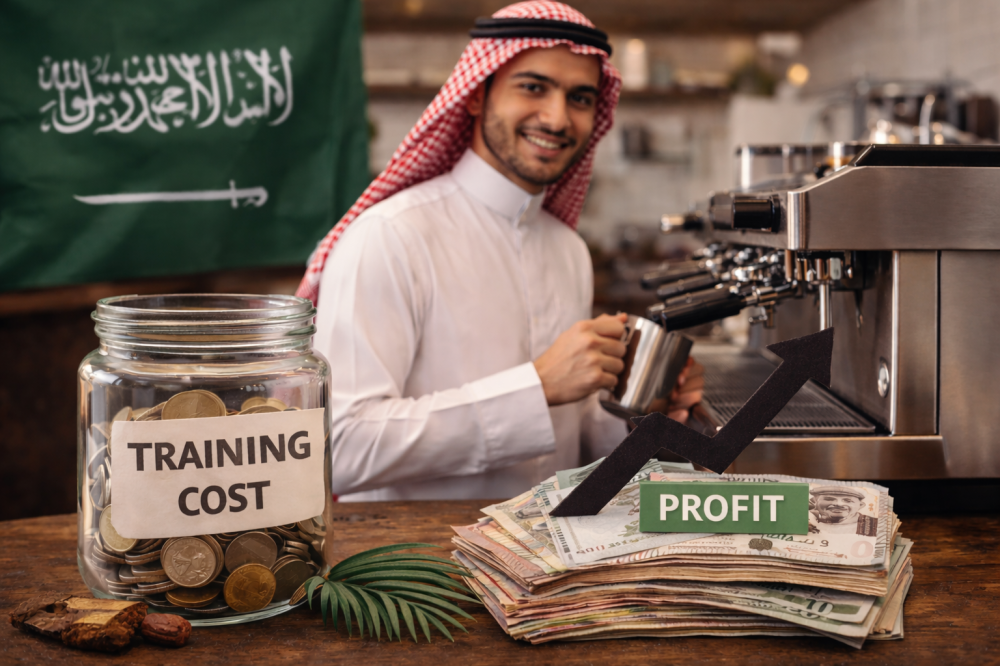
Despite the costs, barista training is a guaranteed win. First, improved quality: A trained barista serves consistent drinks, increasing customer satisfaction and reducing returns by 50%. Second, increased sales: With skills like latte art or drink suggestions, the average bill increases by 20-30%, as seen in Riyadh cafes that have adopted specialized training. Third, building loyalty: Customers return for the quality, reducing marketing costs. Fourth, minimizing waste: Training reduces bean waste by 15% through precise extraction. Fifth, competitive advantage: A cafe with a professional barista stands out in a crowded market. At Luxury Coffee, as a specialty coffee supplier , we offer free training courses with bean deliveries, turning costs into quick profits.
How to calculate the return on investment in barista training
To calculate profit, compare costs and benefits: Assume a cost of 10,000 riyals to train 4 baristas, resulting in a 20% increase in sales (if your monthly sales are 50,000 riyals, you'll see an increase of 10,000 riyals per month). The return on investment is typically seen within 1-3 months. At Coffee Luxury, we assist with these calculations through free consultations.
The most frequently asked questions about barista training
- What is the cost of barista training in Saudi Arabia? It ranges from 500-5000 riyals depending on the level, but at Coffee Luxury we provide economical options with supply.
- How long does barista training take? 3-7 days for the basics, with ongoing training for advanced skills.
- Does barista training actually increase sales? Yes, by 20-40% through consistent and innovative drinks.
- What are the best barista training courses? SCA courses or internships aided by the luxury of coffee.
- How do I measure the profitability of barista training? By increasing customer satisfaction and beverage sales.
Start investing in barista training with Coffee Luxury today
Ultimately, barista training is not an expense but a sustainable profit that enhances the quality of your café and your sales. At Coffee Luxury, we help you achieve this by supplying training equipment and high-quality coffee.