
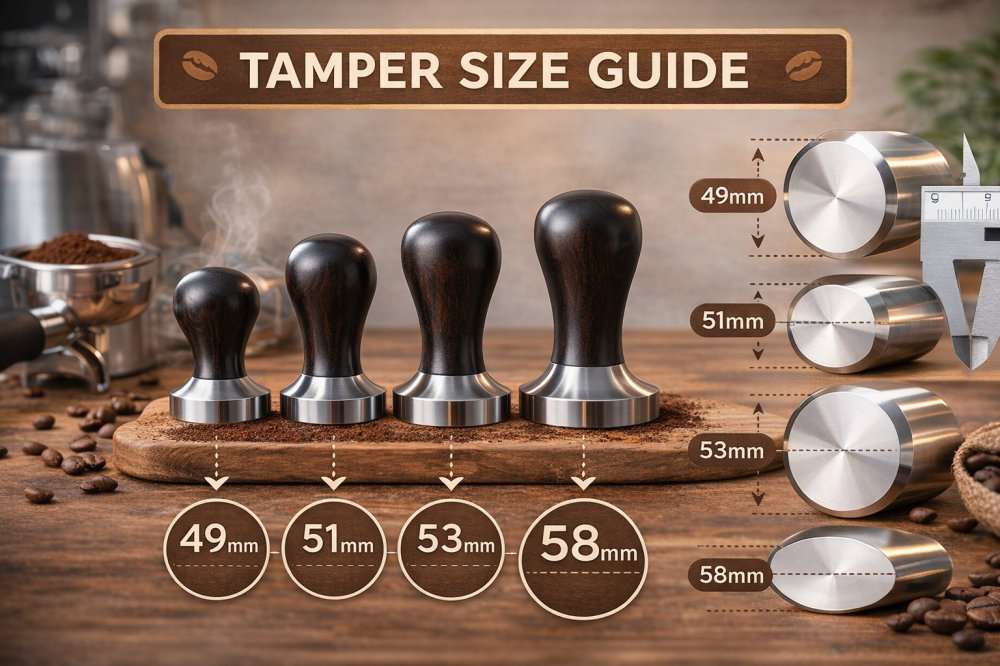
In the world of espresso, the tamper is an essential tool for evenly compressing ground coffee inside the portafilter basket, ensuring a consistent water flow and balanced extraction free from channeling (uneven flow). However, choosing the wrong size can lead to incomplete compression, sediment buildup on the sides, or even damage to the basket. In this detailed article, we'll provide a comprehensive guide to common tamper sizes (such as 58mm, 54mm, 51mm, and others), explaining the differences, how to measure your machine's size, and recommendations based on whether you're using a home or commercial machine. The aim is educational to help you avoid common mistakes, and we've included frequently searched terms like "coffee tamper size guide," "tamper size chart," "58mm vs 54mm tamper," "Breville tamper size," "best tamper size for a home espresso machine," and "how to find your portafilter size."
Why does tamper size matter?
The tamper size must precisely match the diameter of the inner basket (inside the metal filter). If the tamper is too small, it leaves unpressured coffee loops on the sides, causing channeling. If it's too large, it may snag or scratch the basket. The ideal size is slightly smaller than the inner diameter (usually 0.2–0.5 mm less) to allow for smooth passage with even pressure. In professional machines, a precision tamper such as 58.35 mm or 58.5 mm is preferred for VST or IMS baskets.
Common tamper sizes and their uses
Measurements are always given in millimeters (mm) and refer to the diameter of the tamper base. Here's a basic guide based on the most popular machines:
- 58 mm (or 58.35 mm/58.5 mm) : The standard commercial size and the most common size found in advanced professional and home machines. Fits most E61 grouphead machines such as La Marzocco, Rancilio Silvia, ECM, Rocket, Quick Mill, and Gaggia Classic Pro (newer versions). Allows for larger doses (18-22 grams) and a wide pressure surface for better extraction. Recommendation: Choose 58.35 mm or 58.5 mm for precision baskets to avoid side gaps.
- 54 mm (or 53.3 mm/53.35 mm) : Very common in mid-range and high-end home machines, especially Breville/Sage (such as Barista Express, Barista Pro, Infuser, Duo-Temp). Suitable for 16-20 gram doses, it offers an excellent balance of ease of use and quality for both beginners and professional home brewers.
- 51 mm : The most common size in budget and compact machines such as De'Longhi (Dedica, La Specialista, most versions), Saeco, and some Krups or Bodum models. It's suitable for smaller doses (12-18 grams), ideal for simple everyday use, but limits possibilities for lighter roasts.
- Other, less common sizes :
- 57mm: Ascaso, some La Pavoni.
- 53 mm: Some Francis Francis, Isomac old.
- 49 mm: De'Longhi vintage, La Pavoni lever vintage.
- 56 mm: Some Francis Francis X1.
How to find out the exact size of your machine's tamper? (Step-by-step)
- Measure the inner diameter of the basket : Remove the basket from the portafilter, place a ruler or vernier caliper inside the top edge (the part that touches the coffee). Measure the inner diameter accurately (usually 0.1 mm).
- Check the machine manual : look for the model name + "portafilter size" or "tamper size".
- Try the current tamper : if the original tamper goes through smoothly without a large gap, it is the correct size.
- Refer to common size charts :
- Breville Barista Express / Pro: 54 mm (usually 53.3-53.5 mm accurate).
- De'Longhi Dedica / La Specialista: 51 mm.
- Gaggia Classic Pro: 58 mm.
- Rancilio Silvia: 58 mm.
- La Pavoni (modern leaf): 51 mm or 57 mm.
Quick comparison: 58mm vs. 54mm vs. 51mm
- 58 mm : Best possible extraction, larger surface area, less prone to channeling if pressed firmly, ideal for light roasts and large doses. Drawback: Requires stronger pressure and greater precision.
- 54mm : Excellent balance for home use, easy to control, convenient dosing, and less expensive accessories. Drawback: Less flexibility with advanced roasts.
- 51 mm : Easy and simple, ideal for beginners or quick everyday use. Drawback: Lower capacity, weaker extraction in some cases.
Practical tips for choosing the right tamper
- Choose a heavy metal tamper (stainless steel or aluminum) for even pressure (300-400g weight is ideal).
- Base shape: flat for accuracy, convex for beginners.
- If you are using precision baskets (VST/IMS), choose a slightly larger tamper (e.g., 58.35 mm).
- For beginners: Start with a self-leveling tamper or one with a comfortable handle.
- The tamper can be combined with other tools such as WDT or puck screen for better results.
Frequently asked questions about tamper sizes
- How do I find out the tamper size for my machine? Measure the diameter of the inner basket or search for the machine model + "tamper size".
- What is the best size for home machines? 58 mm for professional, 54 mm for Breville, 51 mm for De'Longhi.
- Can a slightly larger tamper be used? No, it may scratch the basket; choose a smaller one, 0.2-0.5 mm.
- What is the difference between 58mm and 58.5mm? 58.5mm is better for precision baskets for full coverage.
- Is the original tamper always the best? Probably not; professional tampers (such as Normcore or Pullman) give better results.
- How much does a good tamper cost? $20-$100 depending on quality and accuracy.
Find the best quality specialty coffee supplies at Luxury Coffee
At Coffee Luxury, we are committed to providing the finest specialty coffee and beverage accessories to enhance your everyday wellness experience. Whether you're looking for a precise 58mm, 54mm, or 51mm tamper, or want to try premium hot chocolate made with organic cocoa, we offer high-quality products at competitive prices.