
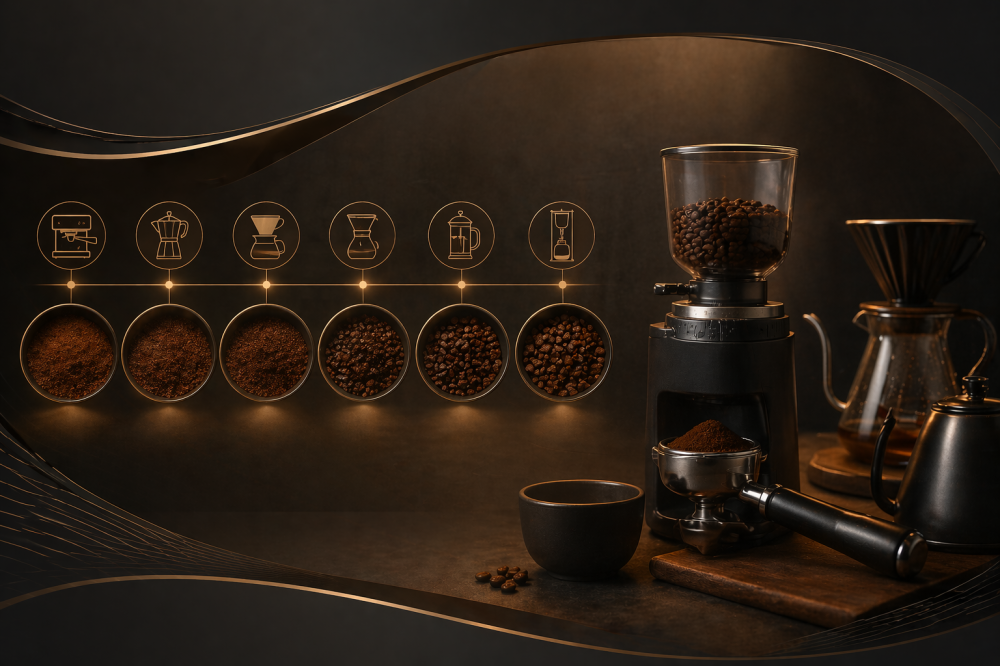
In the world of specialty coffee, grind size is one of the most important factors determining the quality of your cup. Grinding controls the surface area of the beans in contact with water, and therefore the speed and efficiency of the extraction process. A very fine grind increases the surface area, leading to a rapid extraction that may produce bitter and heavy coffee (over-extraction), while a coarse grind slows down extraction and may result in dull and sour coffee (under-extraction).
Choosing the right grind size depends on the brewing method, the time the coffee is in contact with water, the type of filter (paper or metal), and the water pressure. This article will explain the basic principles and then provide a detailed guide to the most popular brewing methods used in cafes and homes in Saudi Arabia.
1. Principles of selecting the grinding degree
- Fine grinding → Suitable for fast methods under pressure (such as espresso) because extraction happens in seconds.
- Coarse grinding → Ideal for long-time methods (such as French press or Cold Brew) to avoid bitterness.
- Balance is key: the goal is to extract 18-22% of the soluble substances in the grains.
- Effect on flavor :
- Very coarse grind: weak, sour, low-bodied coffee.
- Very fine grind: Bitter, heavy, dry coffee in the throat.
- Practical tip : Grind your coffee freshly ground just before brewing. Use a good grinder (such as Comandante or Timemore) for a consistent grind. Experiment and adjust according to your taste, the roast level of the beans (light roast requires a slightly finer grind), and the water hardness.
2. Grinding degree guide according to preparation method
A. Espresso
- Grinding degree : Extra Fine - similar to flour powder or slightly finer than table salt.
- The reason : High pressure (9 bar) and short time (25-30 seconds) require a large surface area for rapid extraction and a rich cream.
- Tip : If extraction is slow (more than 30 seconds) → go slightly coarser. If it's fast (less than 20 seconds) → go finer.
- Common ratio : 18-20 grams of coffee to 36-40 grams of beverage.
b. Moka Pot
- Grinding degree : Fine to Medium-Fine – such as fine table salt.
- The reason : Moderate steam pressure, and the metal filter allows some sediment to enter.
- Tip : Avoid grinding too finely to avoid bitterness or filter blockage.
C. Pour Over (V60, Kalita, Chemex)
- Grinding degree : Medium to Medium-Fine – similar to fine sugar or slightly coarse sand.
- Reason : Gravity distillation requires a balance between speed and extraction. Chemex (thick filter) prefers a slightly coarser grind than V60.
- Tip : For the V60, start with a medium grind (around 600-800 microns). If the coffee is sour, grind finer. If it's bitter, grind coarsely.
Dr. AeroPress
- Grinding degree : Medium-fine to fine (Medium-Fine) – similar to fine salt or slightly finer.
- The reason : A flexible method (immersion + pressure), and the short time (1-3 minutes) allows for finer grinding than the French press.
- Tip : In the inverted method, you can grind finer. Try 15-18 grams to 200-250 ml of water.
e. French Press
- Grinding degree : Coarse - similar to coarse salt or breadcrumbs.
- The reason : The long immersion time (4 minutes) and the metal filter allow natural oils to pass through, but fine grinding causes a lot of sediment and bitterness.
- Tip : Stir gently and don't press too hard. Ideal for full-bodied coffee.
And. Cold Brew
- Grinding level : Extra Coarse - slightly larger than French Press.
- Reason : The long soaking time (12-24 hours) in cold water requires coarse grinding to avoid over-extraction and bitterness.
- Tip : Use a 1:8 to 1:10 ratio (coffee:water). Ideal for hot days in Saudi Arabia.
Z. Turkish Coffee
- Grinding degree : Extra Fine - like flour or coffee powder.
- The reason : Direct boiling without a filter requires the finest grind for complete extraction and the "coffee" layer at the bottom.
H. Drip Coffee (Automatic Drip Machines)
- Grinding level : Medium - similar to regular sugar.
- The reason : The machine controls the flow, so medium grinding provides a good balance.
How do you adjust the grind if you don't like the taste?
- The coffee is sour/weak/pale → grind it a little finer (increase extraction).
- Bitter/Heavy/Dry Coffee → Grind slightly coarser (reduce extraction).
- Change only one or two degrees at a time, then try.
- Record your mill settings (such as the number of clicks in Comandante) for repetition.
5. Additional tips for successful grinding
- Always use a digital scale (a ratio of 1:15 to 1:17 is common).
- Clean the grinder regularly to avoid using old oils.
- Temperature and purified water affect the grinding process.
- For beginners: Start with standard recipes and then modify them to your personal taste.
- In cafes: Train the barista on "Dialing In" grinding daily according to the humidity and grains.
Frequently Asked Questions (FAQ)
Can the same grinding method be used for all methods?
No, each method requires a different degree to avoid a bad taste.
What is the best grinder for home use?
Manual grinders such as the Comandante C40 or high-quality electric grinders for consistent grinding.
Does the type of roasting affect the grinding process?
Yes, light roasting requires a slightly finer grind, while dark roast tolerates a coarser grind.
How can I tell if the grinding is correct without measuring tools?
Try and taste: Coffee should be balanced (sweetness + acidity + mild bitterness) with a suitable body.
Is ready-made flour from the supermarket good?
Often not, because it's not fresh and not suitable for your method. Freshly ground is always better.
Coffee Luxury: Your first destination for specialty coffee lovers
Luxury Coffee is the premier destination for specialty coffee lovers and those looking to supply their cafes or homes in Saudi Arabia. We provide the finest specialty coffee beans from global sources, high-quality professional and manual grinders, a variety of brewing equipment, and all the accessories you need to precisely adjust the grind and achieve exceptional flavors in every brewing method.