
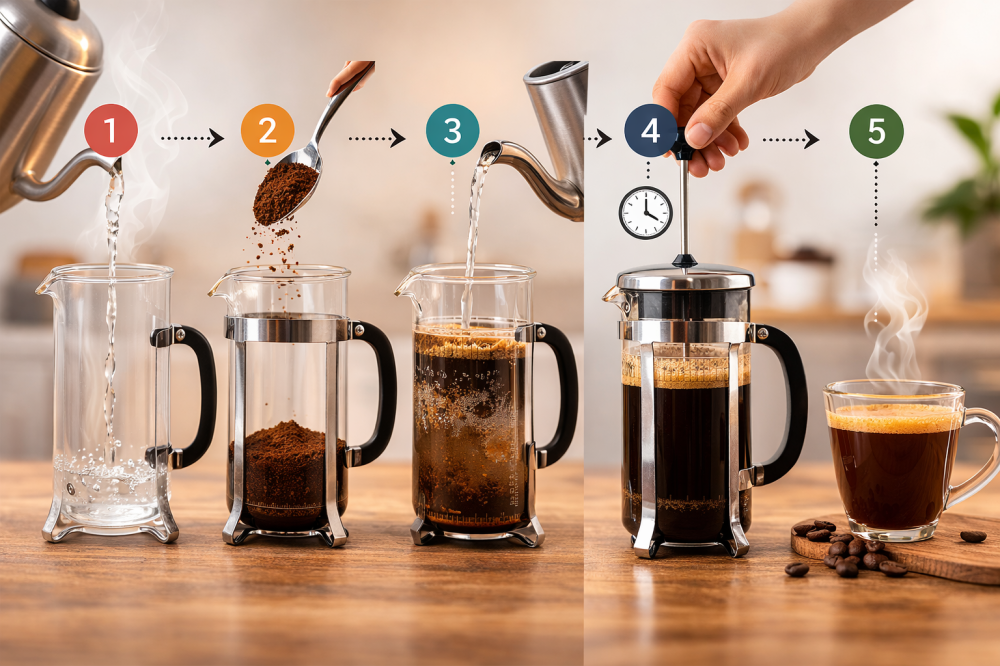
The French press (or cafetière) is one of the simplest and most popular methods of brewing coffee in the specialty coffee world, yet it's also one of the most prone to common mistakes that can turn a delicious cup into a bitter, weak, or sediment-filled one. In this detailed article, we'll present the 100% correct method, based on best practices from experts like James Hoffmann, Stumptown, and Whole Latte Love, focusing on avoiding all the common errors. The goal is educational, to help you achieve a clean, flavorful, and balanced cup of coffee every time. We'll incorporate the most frequently searched terms such as "French press without mistakes," "French press step by step," "coffee ratio in the French press," "coffee grind for the French press," "common mistakes in the French press," and "perfect French press method."
Why do so many people fail at French press despite its simplicity?
The French press relies on full immersion brewing, which produces a rich body and strong flavors, but it lacks a paper filter to remove fine sediment. Therefore, common mistakes such as incorrect grind, low temperature, or high pressure can lead to bitterness, excessive sediment, or bland coffee. The correct method depends on precision in five key elements: grind, ratio, temperature, time, and technique.
Ingredients and tools needed for perfect preparation (for approximately two cups - 500-600 ml)
- High-quality fresh coffee beans (preferably medium to dark roast for French press).
- 30-35 grams of coffee (about 5-6 tablespoons).
- 500-550 ml filtered water (ratio 1:15 to 1:16 - most commonly 1:15.5).
- Coffee grinder (cold grind is best for controlling the coarseness).
- Digital scale and timer (phone app sufficient).
- Hot water (electric kettle or pot).
- A wooden or plastic spoon for stirring.
Detailed steps for preparing French press without any mistakes
- Boil the water and let it cool slightly. Heat the water to 92-96°C (or boil the water and wait 30-45 seconds). Common mistakes to avoid : using very boiling water (100°C) will burn the coffee and produce bitterness, or very cold water will result in a poor extraction.
- Grind the coffee freshly ground to the correct coarseness. Set the grinder to the coarsest setting possible (like coarse salt or crushed toast). The coffee grounds should be distinct and not fine. A common mistake to avoid : a fine grind clogs the metal filter, causing excessive sediment and bitterness, or makes tamping difficult.
- Place the coffee in the carafe and bloom (optional but recommended) . Add 30-35 grams of ground coffee to the French press. Pour approximately 60-70 ml of hot water (a 2:1 water-to-coffee ratio initially) in a circular motion to hydrate all the coffee. Wait 30-45 seconds for the carbon dioxide to escape (you will see bubbles and a rise). A common mistake to avoid : uneven hydration results in an uneven extraction.
- Complete the water pouring and start the timer after the water level rises. Pour the remaining water (until you reach 500-550 ml) in a slow, circular motion to ensure complete saturation. Start the timer immediately after finishing pouring. Place the lid on top of the jug (without pressing down yet).
- Let the coffee steep for the ideal time— exactly 4 minutes (James Hoffmann recommends 4 minutes, some experts say 4:30). At the 4-minute mark, gently stir the surface of the coffee with a spoon to break up the floating crust and remove any large bubbles. A common mistake to avoid : letting the coffee steep for more than 5 minutes increases bitterness, while less than 3 minutes results in a weak, overly sweet brew.
- Press slowly and steadily. Press the piston very slowly (it should take a full 20-30 seconds). Do not press too hard or too quickly. If you feel too much resistance, the grind is too fine. If it goes down too easily, the grind is too coarse. A common mistake to avoid : Pressing too quickly disturbs the sediment and fills the cup with sediment.
- Pour immediately and don't leave the coffee in the pot after pressing; pour it directly into cups. Don't leave it in the French press, as the coffee will continue to be extracted and become bitter. A common mistake to avoid : leaving coffee in the pot for extended periods (very common at family gatherings).
Additional tips to completely avoid common mistakes
- Use a permanent scale at first until you get used to the ratios.
- Clean the French press thoroughly after each use (old residue affects the flavor).
- Try a 1:14 ratio for a stronger coffee, or 1:17 for a milder coffee.
- For cold brew coffee: the same method but with cold water and soaking for 12-18 hours in the refrigerator.
- A French press can be used to make simple milk foam: heat the milk, then press and quickly lift the piston several times.
Frequently asked questions about the correct French press technique
- What is the ideal ratio? 1:15 (Example: 30 grams of coffee to 450-500 ml of water).
- How long is the soaking time? 4 minutes is optimal for most tastes.
- Why do so many deposits appear in Kobe? The biggest reason: very fine grinding or rapid pressing.
- Do I need Bloom? Yes, it improves extraction and reduces bitterness.
- What is the correct water temperature? 92-96 degrees Celsius (boil then wait 30-45 seconds).
- Can cappuccino be made with a French press? A rudimentary milk foam can be made, but it's not as perfect as steam.
For the best specialty coffee supplies, shop now
At Coffee Luxury, we are committed to providing the finest specialty coffee and beverage accessories to enhance your everyday wellness experience. Whether you're looking for a high-quality glass or metal French press, freshly brewed coffee beans perfect for your French press, or even a gourmet hot chocolate made with organic cocoa, we offer premium products at competitive prices.