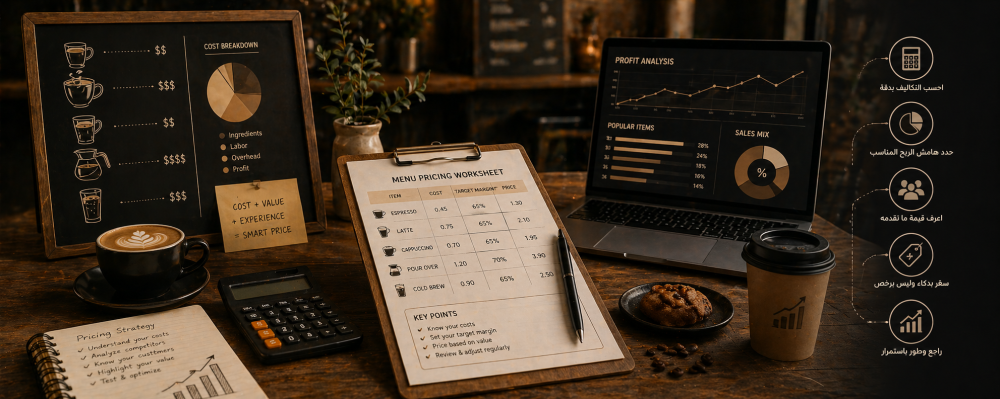
In Saudi Arabia's rapidly growing specialty coffee market, menu pricing is one of the most important factors determining a café's success or failure. Smart pricing isn't just about covering costs and making a profit; it's about focusing on customer perception of value, guiding their choices towards high-margin products, and increasing the average bill without making them feel overpriced.
A specialty coffee shop sells more than just a drink: the quality of the beans, the skill of the barista, the atmosphere, and the unique flavors. Therefore, pricing should reflect this added value in a thoughtful way.
1. Basics of menu pricing in cafes
Before setting prices, accurately calculate the cost structure :
- Cost of raw materials (COGS) : coffee beans, milk, syrups, confectionery. In specialty coffee, the cost of the beverage is often 25-35% of its final price (preferably not exceeding 30% for good profitability).
- Fixed costs : rent, salaries, bills, maintenance.
- Variable costs : filling, cleaning, waste.
- Target margin : Most successful cafes aim for a gross profit margin of 60-75% on beverages.
A simple calculation example for a Latte (medium size):
- Cost of espresso + milk + cup + syrup ≈ 4-7 riyals.
- Suggested selling price: 18-25 riyals (good profit margin).
2. Smart Pricing Strategies
Use a combination of the following strategies to be flexible and effective:
A. Cost-Plus Pricing
Add a fixed markup to the cost. Example: Cost of 6 riyals + 300% markup = selling price of 24 riyals.
Useful as a start, but it does not take into account the perceived value.
b. Value-Based Pricing
Set the price based on what the customer considers valuable.
- Single Origin coffee is rare or from an organic farm → higher price.
- A drink with homemade syrup + organic plant-based milk + Instagram-worthy design → justifies a higher price than competitors.
C. Psychological Pricing
- Charm Pricing : Use prices ending in .99 or .95 (e.g., 19.99 instead of 20). It looks cheaper visually.
- Round prices : For luxury products (e.g., 25 riyals) to give a sense of luxury.
- Decoy Pricing : Place a very expensive drink next to the desired product to make the latter appear to be of "excellent value".
- Anchor Pricing : Put a high price at the top to make the rest of the list look reasonable.
Dr. Dynamic and Seasonal Pricing
- Higher prices during peak times (morning, evening).
- Price offers during quiet times (Happy Hour).
- Seasonal products (cold coffee in summer, warm spiced drinks in winter) are priced higher.
e. Packages and Combos
Encourage an increase in the bill:
- Coffee + dessert for only 5-10 riyals extra (seems like a saving).
- Buy 5 and get the 6th free (loyalty programs).
3. How to price different menu categories in a specialty coffee shop
- Basic coffee (espresso, Americano, filter) : 12-18 riyals. These are "Known Value Items" – don't raise the price too much to avoid alienating customers.
- Complex drinks (Latte, Cappuccino, Mocha, Flat White) : 18-28 SAR. Higher margin due to milk and syrups.
- Innovative cold brew coffee (Nitro, Cold Brew, Specialty Drinks) : 20-32 SAR. The price is justified by the unique experience.
- Non-coffee beverages (tea, matcha, juices) : 15-25 riyals.
- Sweets and snacks : 8-25 riyals. Very high profit margin (often 70-80%).
- Additions (Extra Shot, Plant Milk, Flavors) : 3-7 Riyals per addition – an excellent source of additional profit.
Practical tip : Divide the menu into sections (classic, specialty, cold, desserts) and place high-margin products in the "golden zone" (top left, middle, bottom right).
4. Factors affecting pricing in Saudi Arabia
- The cafe's location (Riyadh and Jeddah have higher prices than other areas).
- Target audience (youth, families, professionals).
- Costs of plant-based milk and imported grains (affected by global fluctuations).
- Competition: Monitor the prices of similar cafes without directly imitating them.
- Inflation, Zakat and Tax: Recalculate costs at least every 6 months.
5. Practical steps for pricing menu items intelligently
- Calculate the cost of each item accurately (use accounting software or Excel).
- Define the target margin for each category.
- Conduct competitor analysis and customer surveys.
- The menu is designed in a way that draws the eye to profitable products (pictures, attractive descriptions, prominent prices).
- Test the pricing (A/B Testing) for two weeks and monitor sales.
- Review the prices periodically (every 3-6 months) with a small, gradual increase (e.g., 1-2 riyals).
6. Common menu pricing mistakes to avoid
- Very low pricing (reduces profit and suggests low quality).
- High pricing without clear added value.
- Prices are not updated as costs rise.
- Ignore the margin of additions and upselling.
- A cluttered menu with no psychological organization.
Frequently Asked Questions (FAQ)
What should the cost of materials be as a percentage of the selling price?
It is preferable that it does not exceed 25-35% in drinks, and less in sweets.
Should I be cheaper than the competitors?
No. Focus on "best value" rather than "cheapest." Customers pay more for quality and a superior experience.
How can I raise prices without losing customers?
Gradually increase the level, highlight improvements (new pills, barista training), and offer temporary promotions.
What role does the digital menu play in pricing?
It allows for quick price updates, adding pictures, and a description of the value of each item.
Do the packages actually increase sales?
Yes, it often increases the average bill by 20-40%.
Coffee Luxury: Your first destination for specialty coffee lovers
Luxury Coffee is the premier destination for specialty coffee lovers and those looking to supply their cafes in Saudi Arabia. We provide the finest specialty coffee beans from trusted sources, professional brewing equipment, barista tools, syrups, and all the supplies you need to serve high-quality beverages that support smart and profitable pricing.