
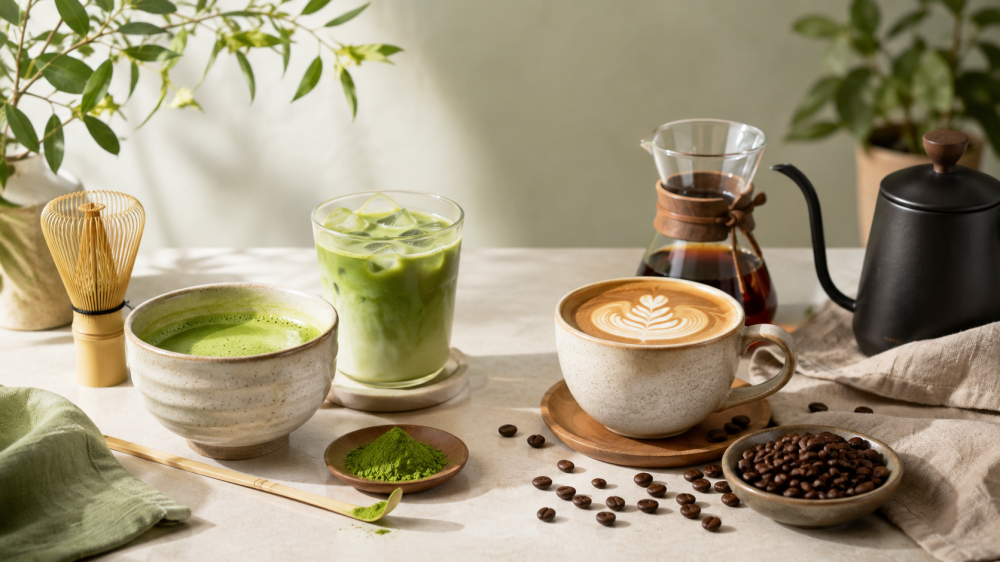
The answer is not simply yes or no. Matcha may be a suitable alternative to coffee for those who want a more moderate dose of caffeine or a different experience, but it is not stimulant-free, nor is it a cure for fatigue or anxiety. Coffee itself is not an unhealthy drink when consumed in moderation and without excessive additives.
In this guide, we explain the difference between matcha and coffee in terms of caffeine, energy, focus, antioxidants, calories, and their effect on the stomach and sleep, while helping you know when matcha is a healthy alternative to coffee and when you don't need to replace it at all.
What is matcha?
Matcha is a type of green tea made from the leaves of the tea plant, which are cultivated, processed, and then ground into a fine powder. Unlike traditional green tea, where the leaves are steeped and then removed, matcha powder is mixed with water or milk and consumed whole.
This is why matcha contains compounds found in the tea leaf itself, the most important of which are:
- Caffeine.
- The amino acid L-theanine.
- Catechins.
- Polyphenols.
- Plant compounds with antioxidant properties.
Many of matcha's potential benefits are linked to its catechin content, particularly EGCG, along with caffeine and L-theanine. Scientific reviews indicate that matcha has a high antioxidant content, but many of its long-term health benefits still require larger, more conclusive human studies.
Is matcha really a healthy alternative to coffee?
Matcha can be a healthy alternative to coffee in certain situations, especially when a person is looking for a beverage with relatively less caffeine or cannot tolerate the strong rush of coffee.
But the word “healthy” depends on four key factors:
caffeine content
Replacing a large cup of coffee with a moderate cup of matcha may reduce your total daily caffeine intake. However, if you consume large amounts of matcha or drink several cups, your caffeine intake may approach that of some coffee drinks.
Additions
Matcha lattes contain large amounts of syrup and sugar and are not necessarily healthier than black coffee without additives.
Body sensitivity
One person may find matcha gentler and more balanced, while another may experience nausea or jitters from it due to the caffeine or taking it on an empty stomach.
The purpose of the drink
If you need a quick pre-workout boost or a long-lasting start to your day, coffee might be the best choice. If you want a more moderate stimulant for work or study, matcha might be more suitable.
Therefore, matcha can be considered a potential healthy alternative, but it is not automatically a better alternative for everyone.
The difference between matcha caffeine and coffee
Matcha and coffee contain caffeine, but the amount varies depending on the method of preparation, the size of the cup, and the amount of the substance used.
Drip coffee typically contains a higher amount of caffeine than a traditional matcha serving, while espresso contains a concentrated amount of caffeine in a small volume. The caffeine content in matcha itself can vary depending on the quality and dosage used.
In most recipes:
- Coffee provides a stronger and faster-noticeable caffeine boost.
- Matcha often provides a lower dose, but it is not always low in caffeine.
- A cup of concentrated matcha may contain a significant amount of caffeine.
- The size of the cup alone does not reveal the amount of caffeine.
The U.S. Food and Drug Administration notes that consuming up to about 400 mg of caffeine per day is not usually associated with adverse effects in most healthy adults, with considerable individual variation in sensitivity and speed of caffeine elimination.
Therefore, the total caffeine intake from coffee, matcha, tea, and energy drinks should be calculated, not from just one beverage.
Why is matcha energy described as more calming?
The most common reason is the presence of L-theanine, an amino acid that occurs naturally in tea.
The combination of caffeine and L-theanine has been studied in multiple trials, with some results showing improvements in attention speed and accuracy, and reduced susceptibility to distractions during mental tasks. Scientific analyses also suggest that this combination may support certain aspects of focus and mood, but the findings should not be overgeneralized.
Therefore, some people may feel that matcha provides:
- Vigilance without strong impulsiveness.
- A calmer focus.
- Less stress than coffee.
- Energy that appears more stable.
- A decrease in desire for a second cup quickly.
However, this feeling isn't guaranteed for everyone. It could simply be that a cup of matcha contains less caffeine than the amount of coffee a person is used to drinking.
Is matcha better than coffee for concentration?
Matcha may be suitable for focusing during long tasks, while coffee is more appropriate for those who want a strong and quick boost of alertness.
Some studies have shown that matcha, or the combination of caffeine and L-theanine, may offer limited benefits for attention, reaction time, and memory, particularly during times of stress. However, reviews indicate that the results are not consistent, and some studies have found only modest effects.
The choice can be summarized as follows:
Choose coffee when:
- You need to wake up quickly.
- You have a short, intensive task.
- She tolerates caffeine well.
- You want a drink before your workout.
- Prefer the flavor of the coffee and the methods of preparing it.
Choose matcha when:
- You want a moderate alarm.
- You feel stressed after coffee.
- It requires concentration for a longer period.
- Opt for a lighter drink in the middle of the day.
- Looking for an alternative to coffee on some days.
Is matcha richer in antioxidants?
Matcha contains antioxidant plant compounds, particularly catechins and polyphenols. Some of these compounds are attributed to consuming the ground tea leaf itself, rather than simply steeping it.
Analytical studies indicate that matcha possesses antioxidant properties and a notable content of polyphenols and catechins. However, the presence of antioxidants does not mean that drinking matcha alone prevents disease or compensates for an unbalanced diet.
Coffee also contains antioxidants, so it cannot be considered devoid of benefits. The difference lies in the type and concentration of plant compounds between the two beverages.
The most important thing is to consume either of them as part of a varied diet, and not to rely on one drink to get all the health benefits.
Which is better for the stomach: matcha or coffee?
The response varies from person to person.
Coffee may cause some people to:
- Acidity.
- Stomach irritation.
- Gastroesophageal reflux disease (GERD).
- Increased bowel movements.
- Discomfort when taken on an empty stomach.
Conversely, matcha may cause:
- Nausea if it is concentrated.
- Discomfort when eating it without food.
- Irritation in those sensitive to caffeine.
- It becomes heavy if milk or syrup is added to it in large quantities.
If you're looking for a coffee alternative due to stomach issues, start with a small amount of matcha after a light meal and observe your body's response. Don't assume matcha will automatically be more soothing.
Is matcha better for sleep?
Matcha may be less potent than a strong cup of coffee if it contains less caffeine, but it is still a stimulating beverage.
Consuming it in the evening may cause difficulty sleeping in sensitive individuals, especially if it is concentrated or comes after several other sources of caffeine.
To maintain sleep:
- Avoid caffeine close to bedtime.
- Reduce the number of caffeinated drinks.
- Choose a small dose.
- Monitor when caffeine starts to affect you.
- Don't assume that matcha is suitable for the night because it is a "calming energy".
The effects of caffeine also depend on age, weight, medications, metabolic rate, and daily habits.
Is matcha better for weight loss?
Neither matcha nor coffee is an independent method for weight loss.
Caffeine and green tea may be associated with a limited and temporary increase in energy expenditure or fat oxidation, but the practical effect on weight is usually much less than that of total food intake, physical activity, and sleep. Furthermore, much of the evidence is insufficient to support the grand marketing claims about “fat burning.”
The drink itself may be low in calories, but the additives change the picture:
- Matcha with water: low in calories.
- Black coffee: low in calories.
- Sweetened matcha latte: May be high in calories.
- Iced latte with sauce and cream: may be high in calories.
Therefore, compare the final recipe, not just the matcha powder and coffee beans.
Is matcha more suitable for those suffering from anxiety?
Some people may prefer matcha because it often contains a lower dose of caffeine than a large cup of coffee, and because L-theanine has been studied for its association with calmness and alertness.
However, matcha does not treat anxiety, and it too may cause nervousness or palpitations if the dose is high or the person is very sensitive to caffeine.
If you experience anxiety after drinking coffee, you can try:
- Reduce the size of the coffee.
- One shot of espresso is enough.
- Try decaffeinated coffee.
- Replace one cup with a mild matcha.
- Drink the beverage after the meal.
- Avoid caffeine in the afternoon.
However, if the symptoms are severe or persistent, you should not rely solely on changing your drink, but rather consult a specialist.
Can coffee be replaced with matcha daily?
Yes, coffee can be replaced with matcha daily if it is well tolerated, but there is no need to do so if you enjoy coffee and it does not cause you problems.
They can also be combined in a moderate way:
- Coffee in the morning.
- Light matcha in the afternoon.
- Decaf coffee in the evening.
- Some days are for matcha and some days are for coffee.
- Reduce the dose instead of eliminating one of them.
The most important thing is to monitor:
- Total caffeine.
- Sleep quality.
- Level of anxiety.
- The stomach.
- Heart rate.
- The amount of sugar in the drink.
How can matcha be a healthy alternative to coffee?
To make matcha a balanced choice, follow these tips:
Choose a good matcha
It is preferable that it be a clear green color, with a fine powder, and stored inside a tightly sealed and opaque container.
Start with a moderate amount
Do not use several spoonfuls on your first try. Start with a small dose, then adjust it according to the taste and your body's response.
Do not use boiling water
Very hot water can increase bitterness and affect the taste. Use water that is below boiling point.
Sift the matcha
The sieve helps to get rid of lumps and achieve a smooth texture.
Reduce sweetener
If the goal is to choose a healthy alternative, do not add large amounts of syrup or sugar.
Choose the right milk
Regular or plant-based milk can be used, but be mindful of the amount of added sugar in ready-made milk varieties.
Do not drink it on an empty stomach if it bothers you.
Take it after a light meal or with food.
Are all types of matcha the same?
No. Matcha varies in origin, quality, color, taste, and method of use.
Matcha suitable for straight drinking is often smoother and less bitter, while the types intended for recipes can be used in lattes, desserts, and cold drinks.
Furthermore, terms like pink matcha or blue matcha don't always refer to the same traditional green tea; they may be products made from different plants or ingredients. Therefore, it's important to read the ingredients and not assume that all products contain caffeine or have the same properties.
The Coffee Luxury blog explains the differences between green, pink, and blue matcha in terms of origin, ingredients, and uses.
Matcha and coffee are a luxury coffee treat
Luxury Coffee Store in Saudi Arabia offers a diverse range of matcha and specialty coffee products and beverage preparation supplies for cafes and homes.
Matcha enthusiasts can set up a complete corner that includes:
- Types of matcha.
- Matcha whisk.
- Preparation bowl.
- The sieve.
- Measuring scales.
- Milk tools.
- Suitable syrups and sauces.
The store also offers specialty coffee beans, coffee grinders, espresso machines, V60 tools, brewing scales, and cafe equipment.
Whether you decide to replace some coffee cups with matcha, or add matcha latte drinks to the cafe menu, Coffee Luxury helps you choose products and tools that give you a balanced taste and a professional brewing experience.
You can also try recipes such as:
- Hot matcha latte.
- Iced Matcha Latte.
- Strawberry matcha.
- Matcha vanilla.
- Pistachio matcha.
- Matcha with plant-based milk.
Browse the matcha and specialty coffee products at Luxury Coffee, and choose the beverage that suits your energy and taste needs, without sacrificing quality or balance.
Frequently asked questions about matcha as a coffee alternative
Is matcha healthier than coffee?
It's not healthier for everyone. It depends on the quantity, the additives, the body's sensitivity to caffeine, and the preparation method.
Does matcha contain caffeine?
Yes, matcha contains caffeine, but it often provides a smaller amount than a large cup of coffee.
Can matcha be drunk instead of coffee in the morning?
Yes, especially for those who want a mild stimulant or cannot tolerate strong coffee.
Does matcha provide energy without stress?
Some people may feel a calmer energy level due to the caffeine dose and the presence of L-theanine, but it may cause jitteriness in sensitive individuals.
Is matcha suitable for those suffering from heartburn?
It may be suitable for some people, but it may cause nausea or discomfort for others. It should be tried in small amounts and after a meal.
Does matcha help with concentration?
Combining caffeine and L-theanine may help with some attention tasks, but the effect varies and is not guaranteed for everyone.
Is matcha suitable for weight loss?
It's not a standalone method for weight loss. What's more important are total calories, activity, and sleep.
How many cups of matcha can you drink per day?
This depends on the amount of caffeine in the recipe and other caffeine sources. Start with one cup and observe your body's response.
Is it possible to drink coffee and matcha on the same day?
Yes, provided you do not exceed the appropriate amount of caffeine for you and monitor your sleep, palpitations, and anxiety.
When is matcha not a suitable alternative?
It may not be suitable for those who are highly sensitive to caffeine, nauseous from it, dislike its taste, or need to follow specific medical instructions regarding stimulants.