
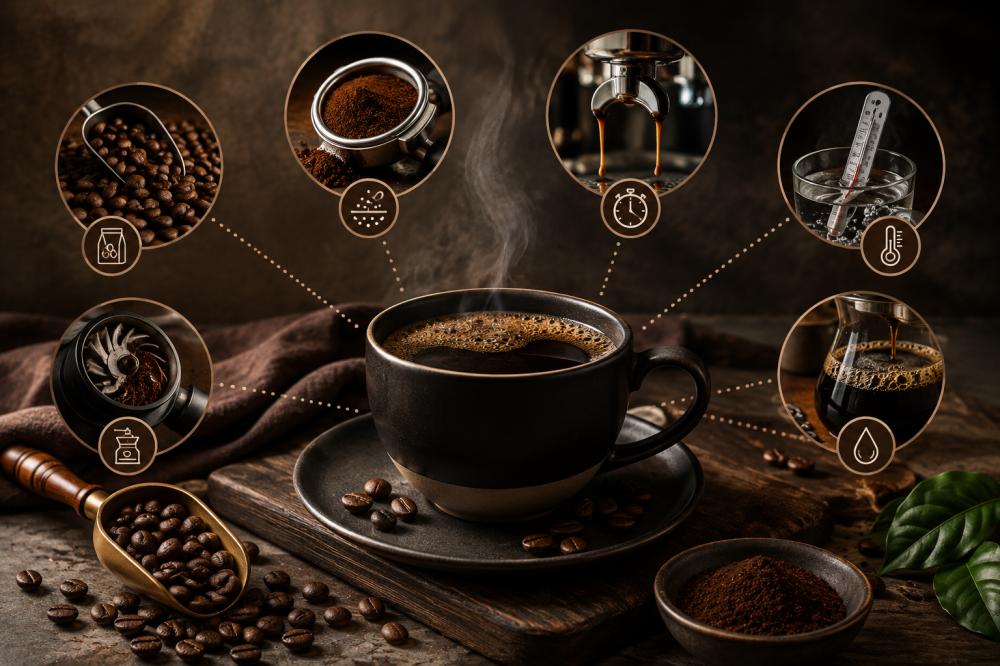
There are cups of coffee that make you pause and search for the chocolate, fruit, or caramel flavors the beans promised. And there are other cups that leave you reaching for a glass of water after the first sip! But before you blame the type of coffee or say the coffee you bought is bad, take a moment to reflect.
Bitter coffee isn't always a defect. In many cases, bitterness is a sign that something went wrong during grinding, brewing, or extraction. The water might be too hot, the grind too fine, the extraction taking longer than it should, or the coffee dosage and water ratio might be unbalanced. Sometimes the reason is simpler: old beans or a dark roast that doesn't suit your brewing method.
In this guide from Coffee Luxury , we will answer in detail the question: What are the causes of bitter coffee? And how can you reduce bitterness and improve the taste of coffee, whether you are making V60 at home or espresso in a cafe.
Is the bitterness of coffee normal?
Before looking for the cause of the bitterness, we must distinguish between normal bitterness and bitterness resulting from unbalanced extraction.
Coffee, by its very nature, contains compounds that can give it a degree of bitterness, so coffee that is completely free of bitterness is not necessarily the goal.
The problem begins when bitterness becomes the dominant flavor, sweetness and other flavors disappear, and a dry, sharp, or burning sensation appears in the mouth.
In specialty coffee specifically, the goal is usually to achieve a balance between sweetness, acidity, bitterness, and texture , so that the characteristics of the beans are showcased rather than one factor dominating the cup.
The main reasons for the bitterness of coffee
1. Grind the coffee very finely.
Grinding coffee is one of the most influential factors in extraction.
When coffee is ground very finely, the surface area of the granules that comes into contact with water increases, and the passage of water becomes slower.
This may lead to excessive extraction, resulting in bitterness and dryness appearing in the cup.
This is clearly evident in methods such as V60 and espresso.
How do you know if the grinding is too fine?
You may notice:
- The water flow is slow.
- Preparation time.
- Bitter or dry taste.
- The sweetness disappeared.
- Unbalancedly heavy build.
the solution
Try making the grinding a little coarser, then prepare it again in the same way.
Do not change the degree of grinding, the amount of water, and the temperature at the same time; because you will not know which factor made the difference.
2. Increase coffee extraction time
The longer the water remains in contact with the coffee, the greater the amount of compounds that can be extracted.
But more time is not always better.
If the extraction exceeds the appropriate level, bitter and dry flavors may begin to appear more clearly.
Therefore, you may find that a V60 recipe that was once excellent becomes bitter after changing the grinding or pouring method.
What do you do?
Monitor the preparation time, but don't rely on it alone.
Taste is the final judge.
If the drink is bitter and dry with a slow flow, start by trying a slightly coarser grind.
3. High water temperature
Water temperature affects the water's ability to extract compounds from coffee.
Using very hot water may increase extraction, especially when combined with fine grinding or a long contact time.
Conversely, water that is too low in temperature may result in insufficient extraction.
Therefore, there is no single ideal temperature for all types of coffee.
Light roast coffee usually needs a relatively higher temperature compared to some dark roasts.
If your cup is bitter, try lowering the temperature slightly while keeping the rest of the variables constant and compare the result.
4. Use a very dark roast
One of the main reasons for the bitterness of coffee is also the type of roasting.
The higher the degree of roasting of the grains, the more the resulting compounds and flavors change, and stronger flavors may emerge, such as:
- Dark chocolate.
- Cocoa.
- Spices.
- Roasting.
- Smoke.
Some coffee lovers prefer this character, but if you're looking for a fruity or floral cup, a dark roast might not be the best choice.
Also, using a very dark roast with a high extraction rate may increase the sensation of bitterness.
Therefore, don't always try to "fix" coffee with a grinder; choosing the type of coffee itself may be the starting point.
5. Over-extracting coffee
Over-extraction is one of the most common answers to the question: Why is coffee bitter?
When water extracts a greater quantity of the required compounds from the coffee, the balanced flavors may disappear and bitterness and dryness may appear.
This can be caused by a range of factors, such as:
- Very fine grinding.
- Water temperature rise.
- Length of contact time.
- Excessive or violent pouring.
- Using a larger quantity of water in a way that alters the extraction process.
It is important to understand here that these factors are interconnected.
The real reason may not be a single factor, but rather a combination of several factors.
6. The amount of coffee is not proportionate to the amount of water.
The ratio of coffee to water affects the concentration of the beverage and the method of extraction.
If you use a large amount of coffee with a small amount of water, you will get a very concentrated cup.
If you use too much water, the drink may become diluted, but this does not necessarily mean it is not extracted.
Therefore, it is best to use a scale during preparation.
In drip coffee, you can often start with a ratio of approximately 1:15 to 1:17 , then adjust it according to the type of coffee and your taste.
As for espresso, different ratios are used depending on the coffee dosage and the weight of the resulting beverage.
7. Not cleaning the coffee grinder
You may have the best grains and the best recipe, but a dirty grinder can affect the result.
Coffee grounds and oils accumulate inside:
- The blades.
- Grinding chamber.
- Coffee outlet.
- The hopper.
Over time, old residues may mix with new coffee, especially when using a dark roast rich in oils.
Some old or rancid flavors may transfer to the new dose.
Therefore, cleaning the coffee grinder should be included in the routine for caring for coffee equipment, especially in cafes that operate for long hours.
8. Using old coffee beans
Fresh coffee does not necessarily mean that the beans have to have been roasted yesterday.
But over time after roasting, the properties of the grains change and they gradually lose some of their aromatic compounds.
When using very old grains, you might get a cup:
- Flavor flatness.
- Less sweet.
- Less obvious.
- Or it carries undesirable flavors.
Therefore, it is important to know the roasting date and the method of storing the coffee.
Store the grains in an airtight container, away from heat, moisture and light, and do not grind a large quantity and leave it for long periods.
9. Water quality
Some may focus on the coffee and the grinder and forget that water makes up the largest part of the drink.
Inappropriate water may affect extraction and perception of flavors.
If the water has an unsuitable mineral composition, the coffee may look:
- time.
- Dull.
- Heavy.
- Or lacking clarity.
Therefore, using clean and balanced water is an important step when preparing specialty coffee .
10. Uneven distribution in espresso
If the bitterness of the coffee is specifically present in espresso, the cause may be channeling or irregular passage of water through the coffee disc.
When the coffee is not evenly distributed inside the portafilter, the water may find an easier path and pass through certain areas more quickly.
This leads to inconsistent extraction; some areas may be over-extracted and others under-extracted.
This is why coffee distribution tools and techniques such as WDT, leveling, and even pressing help improve extraction consistency.
How can you tell why coffee tastes bitter from its flavor?
You can use these indicators as a starting point for diagnosis:
The coffee is bitter and dry + slow brewing
Possible outcome: over-grinding or over-extraction.
Solution: Try a slightly coarser grind.
Bitter coffee + deep roast
The probability: the nature of the roasting.
Solution: Try a lighter roast if you prefer fruity and floral flavors.
The coffee is bitter + the water is very hot
Possible outcome: High extraction temperature.
Solution: Lower the heat slightly and test the result.
Coffee is only bitter in espresso.
Possibility: grinding, dosage, extraction time, or distribution.
Solution: Monitor the dose weight, beverage weight, and extraction time, and gradually adjust the grinding.
How to make coffee less bitter?
If you are looking for a cure for coffee bitterness , don't start by changing everything.
Follow these steps:
1. Taste the coffee first.
Is it just once or once and dry?
2. Monitor the grinding process.
If it's too soft, try making it a little rougher.
3. Monitor the preparation time.
Very slow distillation may be an indication of over-extraction.
4. Check the water temperature.
Try reducing it slightly if the coffee is noticeably bitter.
5. Check the coffee-to-water ratio.
Use a scale and verify the recipe.
6. Clean the grinder.
Especially if you use it constantly.
7. Try a different coffee.
The type of roasting or the characteristics of the crop may be the cause.
Causes of V60 bitterness
When it's a V60 , the most important points to review are:
- Grinding degree.
- Pouring speed.
- Quantity of water.
- Water temperature.
- Distillation time.
- Flowering method.
- Filter type.
- Omar Al-Ban.
If the distillation is too slow, try a coarser grind.
If it's too fast and the coffee is bitter? Don't assume that the grinding is the direct cause; there may be another problem with the recipe, the water, or the type of coffee.
The most important thing is to change one factor at a time.
Reasons for the bitterness of espresso
Espresso is more sensitive to small changes, so keep an eye on it:
- Coffee dose.
- Grinding degree.
- Weight of the espresso.
- Extraction time.
- Water temperature.
- Coffee distribution.
- Pressing.
- Cleanliness of the group and the mill.
If your espresso is too slow and tastes bitter and dry, you probably need to reduce the extraction, and making the grind a little coarser is a good starting point.
Does bitterness mean the coffee is bad?
Not necessarily.
These are some of the most important points to understand when learning how to prepare specialty coffee .
The coffee may be excellent, but the method of preparation is inappropriate.
The coffee may be dark roasted, and this is part of its natural character.
Therefore, do not judge the quality of coffee from just one cup before checking the grinding, water and extraction methods.
How do you choose tools that help you improve the taste of coffee?
If you want to reduce preparation errors, investing in the right tools makes a clear difference.
The coffee grinder gives you control over the degree of grinding.
The scale helps you to stabilize the dose and water.
The right kettle gives you more control over pouring.
Good filters help to achieve a more consistent result in drip coffee.
As for the dispensing and tamping tools, they help to improve espresso extraction.
Here, the process of preparing coffee transforms from guesswork into an experience that can be measured and improved.
Coffee luxury: Tools to help you achieve a better cup
At Coffee Luxury, we believe that a great cup of coffee starts with the small details.
Therefore, we provide coffee lovers and cafes in Saudi Arabia with a range of specialty coffee supplies and preparation tools that help you control every stage, from grinding beans and measuring doses to dripping and preparing espresso and various drinks.
Whether you are looking for a coffee grinder, V60 filters, coffee scale, specialty coffee brewing tools or barista supplies , you can choose the tools that suit your brewing method and level of use.
And don't forget that the best cup is not necessarily the most expensive; rather, it is the cup whose details you know how to adjust.
Frequently Asked Questions
What are the causes of bitter coffee?
The most common causes are over-extraction, very fine grinding, long brewing time, high water temperature, dark roasting, the coffee-to-water ratio not being right, and the use of old beans or unclean equipment.
Why is the coffee bitter even though the beans are good?
The problem might be with the brewing method, not the coffee beans. Check the grind size, water temperature, extraction time, and coffee-to-water ratio.
How can I get rid of the bitterness in coffee?
Start by making the grind a little coarser if the extraction is slow, and check the water temperature, brewing time and coffee-to-water ratio, then test the result by changing one factor at a time.
Why does V60 taste bitter?
The cause may be excessively fine grinding, a long distillation time, high water temperature, or over-extraction. The pouring method and filter used should also be reviewed.
Why is the espresso bitter?
The espresso may be over-extracted due to a fine grind or a long extraction time, or there may be a problem with the dosage, distribution, and temperature.
Does fine grinding make coffee bitter?
This can happen because fine grinding increases the surface area of the coffee and slows down the passage of water, which can lead to over-extraction and the appearance of bitterness and dryness.
Does very hot water make coffee bitter?
Higher temperatures may lead to increased extraction, especially if combined with fine grinding or a long contact time.
Is dark roasting more bitter?
Dark roasts often exhibit stronger roasting-related flavors such as cocoa, smoke, and bitterness, but the final degree of bitterness also depends on the preparation and extraction method.
Should specialty coffee be bitter?
No. Specialty coffee may contain a natural amount of bitterness, but the goal is usually to achieve a balance between sweetness, acidity, bitterness, texture, and the crop's distinctive flavors.
How can I make coffee less bitter without changing the type of coffee beans?
Start by adjusting the grind setting, then check the water temperature, extraction time, and coffee-to-water ratio, and make sure the grinder and brewing equipment are clean.
What is the most important tool for reducing the bitterness of coffee?
No single tool always solves the problem, but a good grinder and an accurate scale help a lot in controlling the grinding, dosage, and water, thus achieving a more consistent extraction.
Does storing coffee affect its taste?
Yes. Prolonged exposure of grains to air, heat, humidity and light may lead to loss of flavor and aroma, so it is preferable to store them in an airtight container and in a suitable place.