
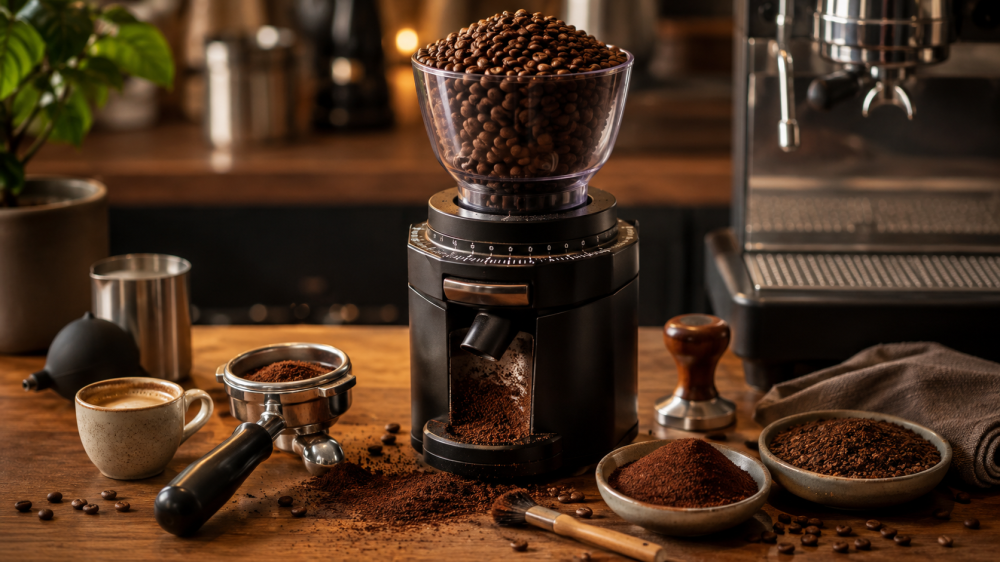
The grinder doesn't just break down the beans into smaller pieces; it also controls the water flow rate, extraction rate, flavor profile, and consistency of each cup. A small error in grind size, cleaning, or operation can turn a well-prepared specialty coffee into a sour, rushed espresso, a bitter, heavy drip coffee, or a beverage that varies in taste from one cup to the next.
Therefore, knowing the mistakes in using coffee grinders is no less important than learning the espresso recipe or how to prepare the V60. The problem is that some of these practices seem very normal; such as leaving the coffee inside the hopper all day, or changing more than one setting at the same time, or cleaning the grinder with water, but they gradually affect the quality of the grind, the life of the machine, and the operating cost.
In this guide we review the top five common mistakes when using a coffee grinder, how they affect extraction, and the correct way to avoid them at home or in a cafe.
Why does the grinder affect the taste of coffee to such a degree?
When coffee is ground, the surface area in contact with water increases. If the particles are fine, the water passes through them more slowly, extracting more compounds. A coarse grind allows the water to pass through more quickly, reducing the extraction rate.
The problem isn't just whether the grinding is fine or coarse, but also the homogeneity of the particles. A mill that produces very large particles with a large amount of fine dust may cause unbalanced extraction; some particles will be under-extracted, while the fine particles will be bitter and astringent.
This is why gear grinders or burr grinders help produce a more uniform grind than blade grinders, and give the barista greater ability to adjust the taste and repeat the recipe.
The Specialty Coffee Association's standards emphasize the importance of consistency and quality in the performance of both home and professional coffee grinders, as consistent grinding is a key element in repeating the result.
The first mistake: Using the same grind setting for all preparation methods
One of the most common mistakes with coffee grinders is setting the grinder to one setting and using it for espresso, V60, French press, and cold brew.
Each preparation method requires a different degree of grinding due to the different time of contact between the water and the coffee and the method of flow.
Espresso typically requires a fine grind because the water is forced under pressure for a short time. Drip coffee usually requires a medium or medium-fine grind, while French press and cold brew use a coarser grind due to the longer brewing time.
When using a coarse grind for espresso, the water passes through quickly and the drink appears:
- Sour.
- Light in texture.
- ashen.
- Short-tasting.
- Not very sweet.
When using a very fine grind for the French press, the drink may become:
- Turbid.
- High sediment content.
- Bitter or astringent.
- Difficult to pressure.
- Uncomfortably heavy.
The Coffee Luxury blog explains that a coarse grind is best for a French press, while a fine grind results in more sediment, a bitter taste, and difficulty in pressing.
How can you avoid this mistake?
First, determine the preparation method, then gradually adjust the grinder.
The following rule can be adopted as a starting point:
- Espresso: Fine grind.
- Mocha Pot: Soft to Medium Soft.
- V60 and Kalita: Medium soft.
- Drip coffee: Medium.
- Chemex: Medium to medium coarse.
- French Press: Rough.
- Cold Brew: Coarse to very coarse.
These aren't fixed numbers; every mill is different. Use the taste, brewing time, and flow rate to determine the appropriate setting.
If extraction is too quick and the taste is sour, make the grinding slightly finer. If it's too slow and the taste is bitter and dry, make it coarser.
The second mistake: not calibrating the grinder when changing the coffee beans.
Some users believe that achieving a good grind setting means they never need to change it again. However, the ideal grind size changes depending on the coffee variety, roast level, and age of the beans.
Lighter roast coffee beans are typically denser and require different handling than darker roasts. The flow rate of espresso also changes over the days after opening the package due to gas loss and changes in bean structure.
Even humidity and ambient temperature can affect the behavior of the grinder and the coffee, especially inside cafes with high operating pressure.
What is the result of not calibrating the grinder?
You may notice:
- Differences in espresso extraction time.
- Change in the weight of the dose discharged.
- A sour taste in the morning and a bitter taste in the evening.
- Rapid flow despite the consistency of the recipe.
- There is a difference between one cup and another.
- High coffee waste.
How is an espresso grinder calibrated?
Start with a proven recipe, such as:
- 18 grams of coffee.
- 36 grams of the final beverage.
- Initial time is approximately 25 to 30 seconds.
If the espresso reaches the target weight too quickly, adjust the grind to a finer consistency. If it takes too long or comes out too slowly, use a coarser grind.
Change only a small setting at a time. After adjusting, discard a small amount of coffee grounds stuck in the grinder's feed tube to ensure the new dose represents the new setting.
Coffee wellness guidelines indicate that the grind should be adjusted according to the brewing method, while keeping the grinder clean and avoiding over-grinding, which raises the temperature of the coffee.
The third mistake: Neglecting to clean the coffee grinder
The mill may look clean on the outside, while on the inside it contains old coffee oils, fine particles, and remnants of previous crops.
These residues accumulate between the burrs and in the coffee outlet, and their oils can develop a rancid taste that mixes with freshly brewed coffee. These build-up can also affect grinding speed, dosage accuracy, and particle uniformity.
Cleaning the coffee grinder is not a cosmetic step, but rather part of extraction quality and preventive maintenance.
The guidelines for cleaning commercial grinders state that using water or spraying liquids inside the grinder is a serious mistake because moisture can reach the electrical parts and cause costly damage.
Signs that the grinder needs cleaning
- The smell of old coffee beans appeared.
- The taste of the coffee changed despite using fresh coffee beans.
- Ground coffee clumps.
- Reduced dose ejection rate.
- Difference in grinding weight.
- Oil has accumulated on the hopper.
- An unusual sound during operation.
The correct way to clean a grinder
First, disconnect the device from the electricity supply, then consult the manufacturer's instructions before disassembling any part.
Typically, the following steps can be implemented:
- Empty the hopper of coffee beans.
- Wipe the hopper with a suitable cloth.
- Remove the top blade if the design allows it.
- Use a dry brush to remove the residue.
- Cleaning the coffee outlet.
- Use cleaning tablets specifically designed for grinders when needed.
- Reassemble the parts correctly.
- Grind a small amount of coffee beans after cleaning.
Avoid washing the metal blades or motor with water, and do not use regular rice to clean the gear grinders; it is harder than coffee grounds and may put pressure on the blades and motor or void the warranty. Maintenance sources recommend using specialized cleaners and following the model's manual instead of random home remedies.
The frequency of cleaning depends on the amount used and the roast type. Dark roast coffee typically contains more surface oils and may require more frequent cleaning than light roast coffee.
The fourth mistake: Leaving coffee beans inside the hopper all day
The hopper is the container on top of the grinder, and its function is to feed the burrs with beans. However, it's not the best place to store coffee for extended periods or overnight.
Inside the hopper, the beans are exposed to light, air, and heat from the mill, which accelerates the loss of aromas and flavors. In cafes, a large quantity of coffee may remain in the hopper until the end of the shift and then be used the following day, despite its continued exposure to air.
Overfilling the hopper can also increase waste when changing crops or when the mill needs to be adjusted.
What problems arise from this?
- Loss of coffee aroma.
- The flavors have become less distinct.
- The espresso flow changed.
- A larger quantity is wasted during calibration.
- Mixing old coffee with a new crop.
- Difficulty in calculating actual consumption.
What is the solution?
Put into the hopper an amount that suits the demand for a limited time, then add more as needed.
At home, the Single Dosing method can be used , whereby you weigh the required amount and grind it directly.
In a café, estimate the expected demand and avoid filling the hopper completely before the end of your shift. Store any leftover coffee in an airtight container away from heat, light, and moisture.
It is also preferable not to return coffee that has been in the hopper for a long time to the original packaging, so that it does not mix with newer beans.
Fifth mistake: Modifying more than one variable at the same time
When the coffee does not taste good, the user may change the grind size, amount of coffee, temperature, extraction time, and water ratio in one attempt.
The result might improve by chance, but it won't be possible to pinpoint the factor that made the difference. And on the next attempt, the bad taste might return because the recipe wasn't understood correctly.
This is one of the most common mistakes that hinder learning how to adjust a coffee grinder.
Why should only one factor be changed?
Because coffee extraction depends on a set of interrelated variables:
- Grinding degree.
- Dosage.
- Water to coffee ratio.
- Preparation time.
- Water temperature.
- Distribution and compression.
- Water quality.
- Omar Al-Ban.
When all variables are constant and only the grinding changes, you can clearly understand its effect.
A practical example of espresso
If the recipe is:
- 18 grams inside the basket.
- 36 grams per cup.
- 20 seconds.
- A slightly sour taste.
Do not increase the dose and change the temperature at the same time. Grind the mixture slightly finer, then repeat the experiment with the same dose and weight.
If the time became 28 seconds and the taste improved, then I knew the reason was the degree of grinding.
An example of drip coffee
If the V60 runs out quickly and the taste is weak, fix the amount of coffee, water and pours, then make the grind slightly finer.
Changing the entire recipe turns the adjustment process into a guesswork rather than a repeatable experiment.
Additional errors affecting the performance of the coffee grinder
Although the five mistakes mentioned above are the most common, there are other practices that may affect the quality of grinding.
Using a blade grinder for specialty coffee
Blade mills cut grains unevenly, potentially producing both large pieces and fine dust. The result is often unbalanced extraction.
Conical or flat gear grinders offer better control and higher uniformity, so they are better suited for espresso and drip coffee.
Ignore the coffee grounds
Some ground coffee remains inside some grinders. When changing the grind size or yield, residue from the previous preparation may come out with the new dose.
Therefore, it is preferable to grind a small quantity after adjustment, especially in commercial mills.
Operating the mill for extended periods without interruption
Continuous grinding can raise the temperature of the motor, blades, and beans. High temperatures affect aromas and may reduce dose consistency.
Choose a grinder appropriate for the size of your orders, and do not use a home grinder for intensive commercial operation.
Ignore code status
The blades wear down over time, causing clumping and less uniform grinding. Signs of wear include slower grinding speed, a change in the grinder's noise, and a decrease in flavor clarity despite cleaning and calibration.
How do you know if your coffee grinder is working properly?
The good performance of the mill can be observed through:
- The doses are similar in weight.
- Clear uniformity in grinding.
- Decrease in agglomeration.
- Stability of extraction time.
- The coffee did not heat up significantly.
- The clarity of the flavors has improved.
- Easy switching between grinding settings.
- The absence of strange sounds or vibrations.
This does not mean that every cup will automatically become perfect, but it gives you a solid base upon which the recipe can be built.
Daily routine of the grinder inside the cafe
To maintain coffee quality and reduce waste, a simple routine can be implemented:
At the start of your shift, test the espresso recipe and record the dose, weight, and time. Check the hopper and coffee outlet for cleanliness, then adjust the grind size if necessary.
During the day, monitor for any sudden change in flow, especially after the temperature of the place rises or the amount of coffee in the hopper decreases.
At the end of the shift, empty the excess coffee according to the storage policy, clean the external parts and the dosing channel, and record any problem that needs maintenance.
As for deep cleaning, it is carried out according to the size of the operation and the manufacturer's instructions.
Coffee grinders and barista supplies from Luxury Coffee
Luxury Coffee Store offers a variety of home and commercial coffee grinders in Saudi Arabia, along with extraction adjustment tools, barista supplies, and cafe equipment.
When choosing a coffee grinder, it's not enough to just look at the appearance or motor power. It's important to evaluate the precision of the grind control, the burr size, the consistency of the dosage, the operating speed, the ease of cleaning, and the grinder's ability to withstand high demand.
Whether you are looking for an espresso grinder for a cafe, a specialty coffee grinder for home use, or a grinder for drip coffee, Coffee Luxury helps you choose the right solution for your brewing method and usage volume.
The store also provides coffee scales, dispensing tools, tampers, cleaning equipment, espresso machines, and specialty coffee, to set up a complete brewing station that reduces errors and improves the consistency of each cup.
Start with the right grinder, adjust it correctly, and keep it clean; because the quality of the coffee starts with the grinding before the extraction process begins.
Frequently asked questions about coffee grinder errors
What is the biggest mistake that affects the taste of coffee?
Using an inappropriate grinding degree for the preparation method is one of the most impactful mistakes, because it causes under- or over-extraction.
Why does the espresso come out of the machine so quickly?
The grind might be too coarse, the dosage too low, or the coffee distribution uneven. Start by making the grind slightly finer while maintaining the rest of the recipe.
Why does my espresso become so slow?
Often the grind is too fine, the dose is too large, or the basket is overfilled.
How often should a coffee grinder be cleaned?
This depends on usage and the type of coffee beans. Commercial grinders require frequent cleaning, while a weekly or monthly cleaning schedule can be set for home use according to the manufacturer's instructions.
Can a coffee grinder be washed with water?
Do not allow water to enter the motor or blades not designed for washing. Use a dry brush and a dedicated cleaning solution, and follow the appliance's manual.
Can a coffee grinder be cleaned with rice?
Using regular rice in gear mills is not recommended, as it may put stress on the blades and motor. Use specialized cleaning tablets.
Does leaving the coffee beans in the hopper spoil them?
It does not spoil it immediately, but it exposes it to air, light, and heat, which accelerates the loss of flavors and affects the stability of the extraction.
Should the grinder be calibrated every day?
In cafes, it is preferable to test the grinder at the beginning of each shift and readjust it when the extraction speed, crop, or weather conditions change.
What is the difference between a blade grinder and a gear grinder?
Blade grinders cut coffee beans less uniformly, while gear grinders grind the beans between two surfaces and provide better control over size.
How do I know when the grinder blades need to be changed?
Signs include increased grinding time, increased clumping, inconsistent dosage, changes in sound, and a decline in coffee quality despite cleaning and adjustment.