
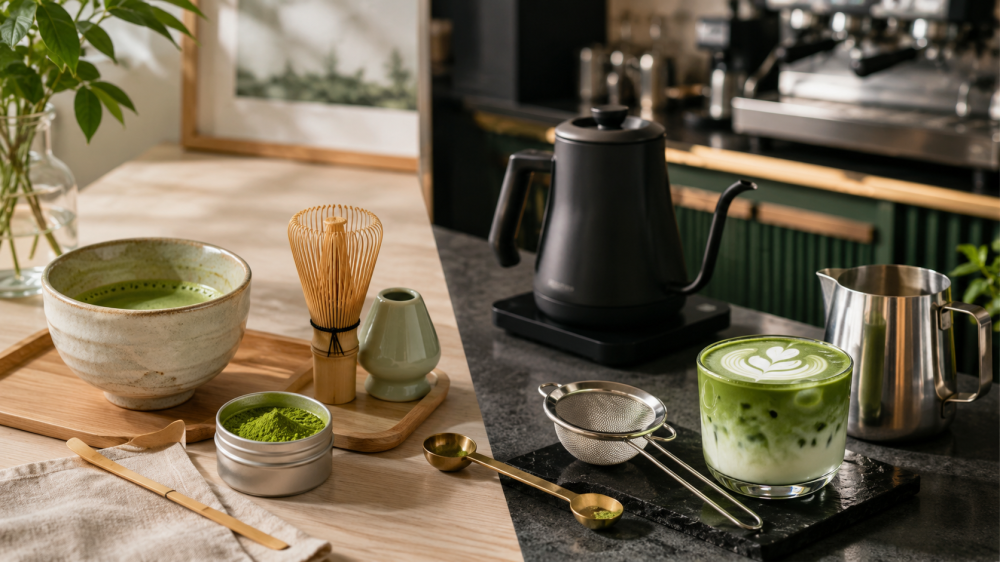
Matcha is not like traditional tea, which is steeped and then strained. Instead, it's a fine powder that is mixed directly with water and consumed whole. Therefore, you need tools to help break up any lumps, control the quantity, and stir at the appropriate speed to achieve a smooth consistency and a consistent foam.
This is why finding essential matcha equipment has become crucial for café owners, baristas, and even those who enjoy making matcha lattes at home. But do you really need a complete matcha set? What are the functions of the matcha whisk, bowl, and sieve? And how do café-grade matcha tools differ from those used at home?
You might have the best matcha powder, choose the right milk, and adjust the sweetener to perfection, only to end up with a lumpy drink, a weak foam, or an unbalanced flavor. In many cases, the problem isn't the matcha itself, but the equipment and preparation method.
In this guide we learn about the most important tools for preparing matcha, the function of each tool, and how to use it, along with practical tips for setting up a professional matcha corner, whether at home or inside a cafe.
Why does matcha need specialized equipment?
Matcha is an extremely fine powder, but it clumps easily when it comes into contact with water if it isn't properly sifted or whisked. Using just a regular spoon is often insufficient to achieve a smooth consistency, especially in both hot and cold matcha latte recipes.
The right tools help to:
- Measure the amount of matcha accurately.
- Remove any lumps before mixing.
- Distribute the water evenly.
- Forming a soft foam on the surface of the matcha.
- Maintaining the consistency of the recipe every time.
- Reducing waste in the cafe.
- Improving the drink's appearance and taste.
Traditional tools used to prepare matcha include a bamboo whisk, a chawan bowl, a chashako spoon, and a sieve that helps to break up the powder before whisking.
The most important basic matcha tools
1. Bamboo Matcha Whisk
The traditional matcha whisk, known as a chasen , is one of the most important tools for authentic matcha. It is often made from a single piece of bamboo that is cut into fine bristles, which help to mix the powder with water and create a light foam.
A matcha whisk is superior to a metal spoon because it stirs the powder quickly in multiple directions, which helps to break up clumps and introduce air into the liquid.
To use it correctly:
- Soak the whisk ends in warm water for a short time before use.
- Place the sifted matcha and water inside the bowl.
- Move the whisk quickly in a W or M shape.
- Avoid pressing too hard on the bottom of the bowl.
- Wash it with water only after use.
- Allow it to dry thoroughly before storing.
In a cafe, more than one whisk should be provided if demand is high, because repeated use without drying may damage or change the shape of the bristles.
ﻻ
2. Matcha whisk holder
The whisk holder, or chasen holder , is not just a decorative item. Its function is to maintain the shape of the whisk after washing, and to prevent the bristles from becoming clogged or bending unevenly.
After rinsing the whisk, place it on a stand to dry naturally. This prolongs its life and maintains its ability to foam.
At home, a whisk holder might seem optional, but it's incredibly useful if you use your whisk daily. In a café, it's an essential tool for maintaining cleanliness and organizing your matcha preparation area.
3. Matcha or Chawan bowl
The traditional matcha bowl is called a Chawan , and it is a relatively wide bowl that allows the whisk to be moved freely without constant collisions with the sides.
Choosing the right matcha bowl directly affects the ease of preparation. A narrow bowl restricts whisk movement, while a wide bowl with a rounded bottom helps create a better foam.
The container should ideally be:
- Wide opening.
- Average depth.
- Fixed on the work surface.
- Made of ceramic or a heat-resistant material.
- Easy to wash.
- Comfortable to hold.
For home use, one traditional matcha bowl is sufficient. However, cafes may require multiple bowls or professional bowls with spouts to easily pour the matcha into iced lattes and layered drinks.
4. Matcha sieve
A matcha sieve is an indispensable tool if you want a smooth, lump-free drink.
Even if matcha powder looks smooth inside the package, it tends to clump due to moisture or pressure during storage. Passing it through a fine sieve before adding water helps separate the particles and makes the blending process faster.
It is preferable to use a fine metal sieve specifically for powders, with a teaspoon to gently push the matcha.
In cafes, a limited quantity can be sifted in advance before peak hours, provided it is stored in an airtight, dark container and not left uncovered for extended periods. At home, it is best to sift the quantity immediately before each use.
5. Traditional matcha spoon
The matcha spoon, also known as a Chashaku , is a thin spoon, often made of bamboo, used to transfer a small amount of matcha powder from the packet into the bowl.
Its advantage is that it allows for taking small doses without compressing the powder, but it's not a precise gram-measuring tool. Therefore, it's suitable for traditional preparation, while a digital scale is needed for coffee to ensure consistency.
Two teaspoons of chashako usually equals a reasonable approximation of a traditional cup of matcha, but the actual weight varies depending on how full the spoon is and the density of the powder.
6. Digital scale
The digital scale is one of the most important tools for matcha in cafes, because it ensures that each cup contains the same amount of powder and water.
Using only spoons can lead to variations in taste from one barista to another, while a scale allows for precise recipe determination, such as:
- 2 grams of matcha.
- 50 to 70 ml of water.
- A specific quantity of milk.
- A fixed amount of syrup or sweetener.
At home you can use a measuring spoon, but a scale is still better if you want to get a consistent result and try more than one type of matcha.
7. Kettle with adjustable temperature
Water temperature is a crucial factor when preparing matcha. Boiling water can increase bitterness and affect the flavor, so it's best to use water below boiling point, generally in the range of 75 to 80 degrees Celsius, depending on the type of matcha and the recipe. Expert guidelines suggest using water close to 175 degrees Fahrenheit (approximately 79 degrees Celsius) helps avoid excessive bitterness.
A kettle with temperature control makes working inside a cafe easier, especially if the bar serves multiple drinks that require different temperatures.
At home, a thermometer can be used, or the water can be left to boil for a short time before being added to the matcha.
8. Pouring jug or measuring cup
After whisking the matcha, the barista needs to pour it over milk or ice without losing any of the drink.
A matcha bowl with a spout, a small pitcher, or a heat-resistant measuring cup can be used. This tool is very useful when preparing layered matcha lattes, as it helps control the pouring speed.
It can also be used to accurately measure water before whisking, which improves the consistency of the recipe within the cafe.
9. Electric Matcha Mixer
An electric mixer is not a traditional tool, but it is a practical solution for some homes and cafes that need faster preparation speed.
The small whisk helps to mix the matcha and create a foam quickly, but it may not give the same texture as a bamboo whisk, especially if the matcha is unsifted.
In a cafe, it can be used as a backup or in times of stress, but it is best to test the result before adopting it in the official recipe.
10. Matcha shaker for cold drinks
To quickly prepare iced matcha lattes or cold matcha drinks, a tight-fitting shaker can be used.
Sifted matcha is placed with a small amount of cold or warm water, then shaken well before being added to the milk and ice.
This method is practical, but it requires making sure the shaker is properly closed and cleaned immediately to prevent color or odor buildup.
11. Milk steamer
If the cafe serves a hot matcha latte, a milk jug is an essential item.
It is preferable to choose a size that suits the amount of milk used in the cup, because a large jug with a small amount makes it difficult to control the steaming.
The milk should be heated to a suitable temperature without boiling, creating a smooth foam that complements the matcha's texture. Whole milk, oat milk, or almond milk can be used, depending on the menu.
12. Matcha cups and serving utensils
Presentation is an important element in matcha drinks, especially in cafes that rely on photography and sharing via social media.
Clear cups are suitable for iced matcha lattes because they show the layers between the milk and matcha, while ceramic cups are suitable for hot drinks.
The matcha corner can also be equipped with measuring cups, stirring spoons, ice packs, and garnishes if the cafe serves strawberry, pistachio, or white chocolate matcha.
The difference between matcha equipment for cafes and home use
At home, it's enough to start with a simple set that includes:
- Matcha whisk.
- A wide bowl.
- A small sieve.
- A measuring spoon.
- boiler.
- Serving cup.
However, a cafe requires more organized and durable equipment, such as:
- Several whisks and stands.
- Multiple containers.
- Digital scale.
- A kettle with varying temperatures.
- Measuring cups.
- A milk evaporator.
- Shaker for cold drinks.
- Airtight containers for matcha powder.
- A schedule for cleaning and maintaining the tools.
The main difference is that home-based businesses focus on ease of preparation, while cafes need speed, consistent quality, and minimal waste.
How to choose the right matcha set?
When buying a matcha set, don't choose based solely on appearance. Make sure the tools are practical and easy to use.
Look for a whisk with flexible bristles, a wide bowl, a fine sieve, and a suitable whisk holder. If the set is for commercial use, choose tools that can withstand frequent washing and don't take up too much space in the bar.
The set does not necessarily have to contain all the tools, as the scale, kettle and milk jug can be purchased separately according to your needs.
Common mistakes when using matcha tools
One of the most common mistakes:
- Do not sift the matcha before whisking.
- Use very boiling water.
- Press firmly on the whisk.
- Store the whisk while it is wet.
- Using an inconsistent amount of powder.
- Leave the matcha exposed to air and light.
- Using a very narrow container.
- Add a large amount of water before dissolving the powder.
- Do not clean the tools immediately after use.
Matcha should also be stored in an opaque, airtight container away from light, heat and moisture to preserve its color and taste.
How to set up a professional matcha corner in a cafe?
Start by designating a space near the milk and ice, with a shelf allocated for utensils and containers.
Keep a sieve, scale, and whisk within easy reach of the barista, and store the matcha in an airtight container. Prepare a recipe card specifying the amounts of matcha, water, milk, and sweetener for each cup size.
Also, make sure you have separate utensils for matcha so that it does not mix with the flavor of coffee or other sauces, especially the whisk and bowl.
If demand is high, a separate station can be set up that includes a small kettle, scales, bowls, whisks, and a milk jug.
Matcha tools and cafe supplies from the luxury of coffee
Coffee Luxury provides a variety of cafe supplies, specialty coffee and various beverages in Saudi Arabia, helping cafe owners and matcha lovers to set up a complete preparation corner.
You can find matcha products, barista tools, measuring cups, kettles, preparation scales, milk tools, syrups, and sauces suitable for developing a hot and cold matcha latte menu.
Coffee luxury also helps you choose products that suit your operating size, whether you are setting up a new cafe or looking for home matcha equipment to prepare your daily beverage.
Browse the matcha and beverage supplies at Coffee Luxury, and start with the right tools that will give you a consistent taste, smooth texture, and a more professional brewing experience.
Frequently asked questions about matcha tools
What are the most important matcha tools for beginners?
The whisk, bowl, sieve, and measuring spoon are the basic tools; the scale and kettle can be added later.
Is a matcha whisk necessary?
Yes, if you want a smooth texture and good foam. An electric mixer can be used as a practical alternative, but it doesn't always give the same traditional result.
What is the difference between a matcha whisk and an electric mixer?
A bamboo whisk provides better control and a more traditional texture, while an electric whisk is faster and easier but may introduce excess air or leave lumps if the matcha is not sifted.
Why should a matcha sieve be used?
Because it breaks up lumps and helps the powder dissolve better when whisking.
Can a regular bowl be used instead of a matcha bowl?
Yes, provided that it is wide enough for the whisk to move and stable on the work surface.
How many grams of matcha does a cup need?
Most recipes start with about 1.5 to 2 grams, and the amount can be adjusted depending on the type of matcha and the size of the drink.
What is the ideal water temperature?
It is preferable to use water that is less than boiling, and a temperature close to 75 to 80 degrees Celsius is often suitable for most recipes.
How do you clean a matcha whisk?
Rinse with warm water without soap, then place on the rack to dry thoroughly.
Are the matcha tools used in cafes different from those used at home?
The basic tools are the same, but a cafe needs a larger number, an accurate scale, a kettle at a specific temperature, and tools that can withstand frequent use.
How should matcha powder be stored?
Store in a tightly sealed, opaque container away from heat, light, and moisture, and follow the product instructions after opening.